A small top tube bag can cost more to manufacture than a larger handlebar pouch. The top tube bag may need a stiff base, a zipper that follows a tight curve and mounting straps positioned within a narrow tolerance. The handlebar pouch may have a simple cylindrical body and two standard straps. Fabric area tells you part of the story. The number of operations, the way the bag attaches to the bicycle and the tests needed to release it can explain the rest.
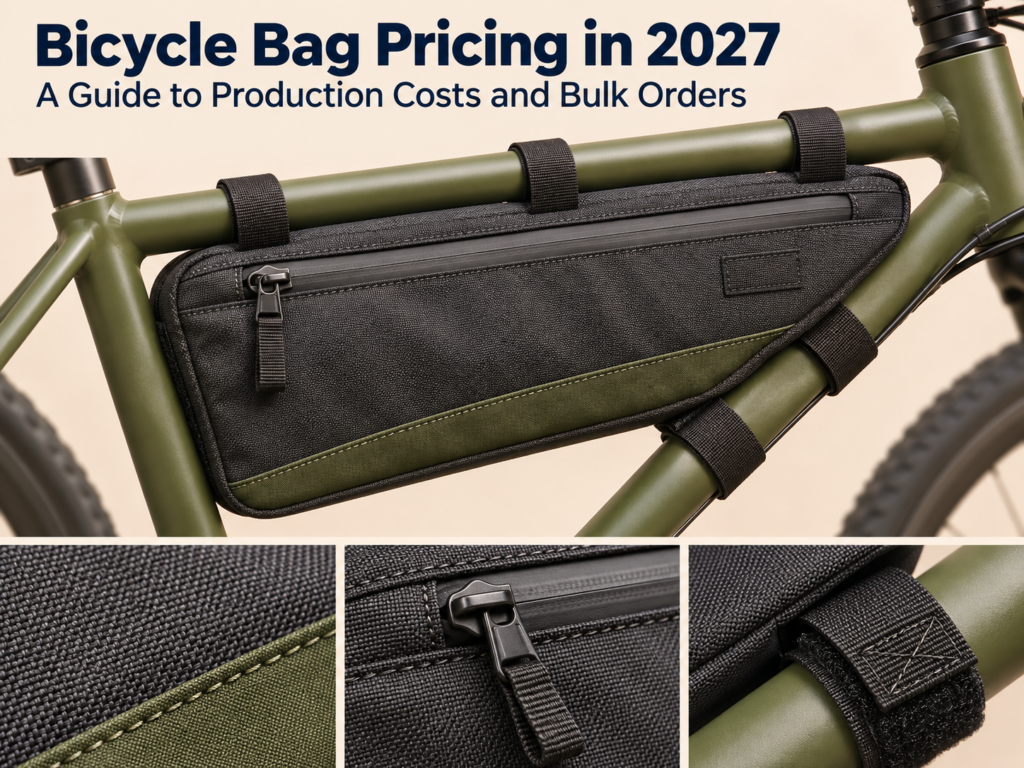
If you are budgeting for a 2027 launch, start by defining the bag, the mounting system and the quantity per variant. Then compare factory quotes at the same delivery point and calculate the cost of getting saleable units into inventory. This guide uses illustrative dollar figures to show how those calculations work. The figures are planning examples. A live quotation will depend on the approved specification, order mix, destination and shipment schedule.
Which bicycle bag are you pricing?
A saddle pouch for tools, a bikepacking seat pack and a rear-rack pannier all carry gear, but they put the load into the bicycle through different attachment points. A small pouch can often use standard webbing and a straightforward closure. A pannier may need a rigid backing, a set of upper hooks, a lower stabilizer and extra time to assemble the hardware. A full-bike travel bag is a separate project, with large padded panels, internal retention and a shipping footprint that can dominate the budget.
Before comparing prices, confirm what constitutes one unit. A pannier quote can refer to one bag or a pair. A handlebar harness may be sold with or without the removable dry bag. A rack bag may be quoted with the attachment plate as a separate line item. Put the saleable configuration in the request for quotation so the supplier can identify everything that has to go into the carton.
| Bicycle bag type | What the buyer is paying for | What to establish before requesting a quote |
|---|---|---|
| Compact saddle pouch | Small sewn panels, zipper, saddle-rail straps and any stabilizing strap | Tool-kit dimensions, intended rail and seatpost fit, and the loaded shape |
| Top tube bag | A narrow pattern, shaped opening, reinforcement and strap or bolt-on mounting | Mount spacing or strap positions, usable width and access with the rider on the bike |
| Handlebar bag | Front retention, steering clearance and any stand-off spacers or harness | Bar geometry, cable routing, packed dimensions and whether the harness is included |
| Frame bag | Bike-specific panel geometry, attachment points and pattern grading across sizes | Frame drawings, size mix, bottle clearance and whether each size needs a separate pattern |
| Bikepacking seat pack | A longer load path, compression, stiffening and control of side-to-side movement | Packed load, attachment geometry, and clearance on the intended bicycle configurations |
| Rear-rack pannier | Upper hooks, lower retention, backing and hardware assembly | Rack compatibility, closure, hardware set and whether the order is for singles or pairs |
| Rack-top trunk bag | Base structure, retention to the rack and any expandable or divided sections | Rack interface, closed and expanded dimensions, and included mounting components |
| Bicycle travel bag | Large padded panels, retention points, dividers and handling features | The bikes it fits, packing configuration, carton dimensions and whether it ships assembled |
Price a configuration that can be fitted and checked
A capacity target is useful for merchandising. For manufacturing, describe what goes inside and what happens to the shape when it is full. A top tube pouch can grow wide enough to interfere with pedaling. A handlebar roll may sit comfortably when empty and reach closer to the front wheel once packed. A frame bag can fit the outline of a frame on paper yet cover bottle mounts or interfere with access to a shock. Give the supplier drawings, dimensions or representative bicycles for the intended fit range.
Specify the bag’s intended load and whether it is supported by straps, direct mounts or a rack. Include the range of bicycle configurations you intend to list as compatible. Ask the factory to fit a loaded sample using the production mounting components. For front-mounted bags, the check should cover steering movement and clearance around controls and cables. For a seat pack or pannier, check wheel and heel clearance, as applicable, at the loads and settings in the specification. The result helps define both the construction and the compatibility information you can put on the product page.
What makes up the factory price?
A factory calculates the quote from materials, cutting, assembly, hardware, packaging and the work required to make and check the order. A quote may incorporate overhead and margin in its unit price, while development, tooling or testing appear as separate charges. Buyers rarely need the factory’s internal cost sheet. They do need an itemized commercial offer that shows the assumptions likely to change the price.
Fabric cost includes cutting yield
A fabric price per metre becomes a bag cost only after the factory knows how many usable panels it can cut across the roll. A narrow half-frame bag may have long, angled panels that leave awkward gaps in the layout. When the face has a directional print or texture, panels may have to face the same way, which can further reduce yield. Compare the cost of the cut set for each size if the bag comes in several geometries. An inexpensive fabric can become less economical if it cuts poorly in the available width.
Ask the supplier to identify the fabric article, finished weight, usable width, face treatment and backing. A denier description identifies yarn linear density and leaves room for differences in weave, coating and finished weight. If two offers both specify 600D polyester, compare the actual swatches and the role of the material. The body of a commuter pannier, the panel behind its rack hardware and the patch that rubs against a rack tube do different work. Select the material by panel and specify what any alternative has to match.
For a multi-size order, ask whether the sizes can be cut from a common fabric purchase and whether the supplier can combine their layouts without mixing cut parts on the line. A common shell can reduce the number of material purchases even when each size still requires its own pattern and inspection measurements. A special colour or laminate can add a mill minimum across the entire run, regardless of how many finished units the factory is willing to sew.
The assembly sequence determines labor
A shell with four main panels can still have many assembly steps. The factory may sew a zipper to a shaped opening, add lining, attach internal pockets, reinforce each strap point, bind the raw edges and close the final seam through several layers. The last operation may require a separate setup if the bag is hard to turn or the seam is difficult to reach. Ask which parts of the design account for the biggest difference between a base quote and an upgraded quote.
Look at the order of operations in a sample review. A label on an accessible cut panel is easy to place consistently. A label applied after the bag is closed can be difficult to position around hardware. An internal divider may require the operator to hold several layers in alignment while closing the gusset. Small changes to panel geometry or the assembly order can reduce handling time and variation without changing the bag’s intended use.
A size run changes labor too. On a frame bag, the same visual design can require different zipper lengths, different reinforcing locations and new cutting templates. Small runs in several sizes mean more changes at the sewing line and more samples to measure. If the sales forecast is uncertain, ask for separate prices for a smaller launch assortment and for the full range. The difference will show how much the additional SKUs cost at the planned volume.
Mounting parts can cost more than the visible fabric upgrade
Simple hook-and-loop straps and standard buckles can work for a light pouch with a clearly defined fit range. A rack-mounted bag may need adjustable hooks, a lower retainer, a backing board and fasteners. A detachable handlebar bag can require a bracket, release mechanism and included spacers. Each part has a purchase cost and a cost to install, inspect and pack. Ask the factory to quote the complete installed set, including inserts and any pieces the rider receives loose.
An existing mount is often a good development starting point. Ask for its drawings or compatible dimensions, installation method, replacement availability and confirmation of how it will be attached to the body. If a bespoke mount is part of the product, budget for development samples and tool charges as well as the unit price. Establish who will own the tool, how later modifications are charged, and how spare hardware will be supplied. Keep any ownership and storage terms in the order documents.
Inspect the mounting hardware as an assembly. A hook may engage a rack tube on the sample but leave too much play when the bag is filled. A fastener can be easy to reach during assembly and difficult to replace once a liner covers it. A mounting plate may need a wider backing area to spread the load. These are reasons to resolve the hardware before setting the final price and packaging.
Water resistance depends on the full construction
A fabric treatment, a coated backing and a welded seam address different routes for water to enter. A surface finish helps water bead off the face. A coating or laminate can improve resistance to penetration through the fabric. Stitch holes, a closure and mounting points remain part of the finished bag. If a quote describes the fabric as waterproof, ask what water performance the supplier has quoted for the assembled bag.
A sewn bag with a covered opening can be appropriate for a specified level of rain exposure. A welded body with a compatible laminate and roll closure can support a different performance requirement, provided the finished design is verified. Sewing, seam sealing and welding call for different equipment and operating steps. A welded construction also needs attention at panel intersections, folds and attachment areas. Ask for a construction drawing and agree on the allowable ingress and the inspection points before freezing the cost.
Use swatch testing for material selection and a separate exposure check on the finished sample. ISO 4920 covers fabric surface wetting by spray. ISO 811 covers fabric resistance to penetration under hydrostatic pressure. For the bag itself, define the exposure, duration, orientation and acceptance criteria that support the intended product claim. A bag mounted behind a saddle may need to be checked in a different position from a pannier attached to a rack.
Decoration and packaging belong in the first quote
State how the product will be sold. A direct-to-consumer bag might ship in a protective sleeve with an installation card. A dealer programme may need a hangtag, a barcode and a presentation that makes the mounting pieces easy to see. A pannier set may need a carton large enough to protect both backing boards and keep the hardware from marking the shell. Send artwork, labeling needs and packaging dimensions early enough to price the actual configuration.
Check the placement of decoration on a packed sample. A print can look centred when the bag is flat and sit too close to a seam after the bag takes shape. A large patch can stiffen a small front panel or change how it bends around a zipper. Ask for setup charges separately and specify whether a change of artwork or print colour creates another charge. For packaging, request carton count, outer dimensions and gross weight. The cheapest unit presentation can become expensive if it limits how many bags fit in a carton.
Illustrative production costs for three builds
The following worksheet uses an order of 1,000 saleable units per style. The pannier example is for one bag with its complete mount. The table shows a hypothetical breakdown of a quoted unit price and assumes standard decoration and a simple unit pack. Assembly and factory allowance are grouped for illustration. Sampling, tooling, independent testing, international freight and import charges would be added where applicable. The figures are hypothetical USD inputs for budgeting.
| Cost per saleable unit | Sewn top tube bag | Reinforced frame bag | Roll-top pannier with rack hardware |
|---|---|---|---|
| Fabric, reinforcement and lining | $1.45 | $2.60 | $4.10 |
| Closure and mounting components | $1.10 | $1.85 | $4.20 |
| Assembly, routine checks and factory allowance | $1.95 | $3.35 | $5.50 |
| Standard decoration and unit packaging | $0.50 | $0.70 | $1.00 |
| Illustrative quoted unit price | $5.00 | $8.50 | $14.80 |
The example shows how to interrogate a quote. The gap between the frame bag and pannier includes more than the fabric. It also includes the rack hardware and work needed to install it. If the product requires a rigid backing, verify where the supplier included it. If the quote assumes an existing hook system, ask which rack dimensions it fits. A factory quote comparison becomes useful once the buyer knows which components are included and which design differences account for the price gap.
The same approach works within a category. For a handlebar bag, request a base version with sewn strap attachments and a second version with a detachable harness. Keep the capacity, shell and decoration comparable where possible. You can then see the cost of the new hardware and any changes to reinforcement and assembly. If the harness is also sold as a spare, obtain its separate price and packaging dimensions.
Bulk pricing depends on the order mix
Read the minimums by style, size, colour and component
A factory may agree to 1,000 pieces of a style and still require a minimum of 300 pieces per colour. A fabric mill may sell a custom colour by the roll, while a buckle supplier may require a separate minimum for each colour of hardware. A frame bag with three patterns can create an additional minimum at the size level, even if all three use the same shell.
Suppose you want 1,000 frame bags split across two colours and three sizes. The total volume sounds straightforward. If each colour is divided evenly across three sizes, the six combinations average about 167 pieces each. A supplier that quotes a minimum of 300 per colour can accommodate that distribution if size-level minimums allow it. A supplier that quotes 300 per size and colour would require at least 1,800 pieces for all six combinations. Ask for the order grid to be attached to the quotation so the factory and buyer can see the same quantities.
If the range misses a minimum, consider which design choice creates it. Stock fabric may remove the dye-lot requirement. A common black mount can reduce hardware variants across the range. A launch with two frame sizes can reduce pattern and sample work, provided those sizes cover the bicycles you intend to serve. The cost discussion is more productive when the supplier identifies the exact material or process behind the minimum.
Spread setup charges across the units that use them
Custom development can involve a pattern fee, print setup, cutting dies, a welding fixture or a tool for molded hardware. Ask which charges apply once, which recur for new colours or sizes, and what happens if the approved design changes. A one-time fee has a different effect on the first order and on a repeat order using the same approved tooling.
For example, a $600 setup adds $1.20 per unit to a 500-piece launch or $0.30 per unit to a 2,000-piece run. Those amounts explain the effect of volume on the setup fee. The purchase decision still depends on how many units you expect to sell and how much inventory you want to hold. If a tool serves one mount across several products, identify which orders will use it and who pays for maintenance or replacement.
Request quotes at the volumes you can realistically place. A quantity break at 3,000 pieces is useful information for a forecast. If the first order is 800 pieces, compare the offers at 800 and include any fixed charges. Ask whether the supplier can keep the same fabric and hardware for a reorder. When a low first price depends on a limited material lot, have the next available material quoted before relying on that price for a range plan.
Turn the unit quote into a landed budget
A quote is comparable once you know what the price includes and where delivery takes place. Ask for the named place or port and the agreed trade term. Confirm whether the quote includes origin handling, main carriage, destination handling or delivery to your warehouse. For an imported order, have the classification, origin and current charges verified for the actual shipment. Keep freight and import estimates dated so the budget can be refreshed before the order ships. The International Chamber of Commerce publishes the Incoterms rules and guidance on specifying the named place.
Carton dimensions matter as much as unit weight for some bicycle bags. A rigid-backed pannier or a padded travel bag may fill a carton while leaving much of its weight allowance unused. Obtain dimensions from a trial pack and ask the forwarder how the proposed shipment will be rated. If the manufacturer proposes nesting two bags or removing hardware for packing, confirm that the contents arrive undamaged and can be assembled as intended. Loose hooks, spacers and screws still need to be counted and kept with the correct unit.
Here is a hypothetical landed-cost worksheet for 1,000 single panniers at the $14.80 unit price above. Every figure is an illustrative allowance in USD. Confirm which lines apply to your shipment and replace the allowances with current quotes and verified charges.
| Budget line | Illustrative amount | Basis |
|---|---|---|
| Production and standard packaging | $14,800 | 1,000 single panniers at $14.80 |
| Development and setup | $450 | One-time order charge |
| Independent inspection and testing | $350 | Order-level allowance |
| Main freight and associated handling | $1,650 | Shipment allowance |
| Applicable import charges and clearance | $950 | Illustrative combined allowance |
| Final delivery to the warehouse | $300 | Shipment allowance |
| Total landed budget | $18,500 | $18.50 per ordered unit |
If 20 units are set aside as service stock, the same $18,500 spread over 980 units equals about $18.88 per unit available for sale. Use the basis that matches your internal pricing model and keep ordered quantity visible. A buyer reviewing two quotes may otherwise compare a delivered price per ordered unit with an internal target that assumes fewer units will be available to sell.
A retail price includes decisions beyond manufacturing and transport. A dealer channel and a direct-sales channel can carry different selling costs, allowances and return provisions. Work back from your expected net revenue per unit and the costs your business needs to cover. That gives you a target landed cost to share with the product team. Where the product is over target, ask the factory which design changes would close the gap and what each would do to fit, appearance or performance.
Compare carton volume before approving the pack-out
Take a padded bicycle travel bag as an example. The buyer may be able to fold a soft shell for shipment, while rigid inserts or wheel dividers set a minimum carton size. Ask the factory to trial-pack the final configuration and photograph how the pieces sit. If a divider is folded in a way that leaves a permanent crease, or a wheel bracket presses against the face fabric, the apparent freight saving can turn into damage at receiving. Check the product after unpacking and assembling it.
The same calculation applies to smaller bags with rigid mounts. Imagine two trial cartons that each hold ten units. A carton measuring 60 × 40 × 45 cm occupies 0.108 cubic metres. A 60 × 40 × 35 cm carton occupies 0.084 cubic metres. For 1,000 units packed ten to a carton, those dimensions imply 10.8 and 8.4 cubic metres of carton volume respectively, before pallets or other shipment allowances. Use the difference to request comparable freight estimates. The final transport charge depends on how the shipment is rated and on any space or handling minimums.
If a smaller carton requires the factory to remove a mounting plate, carry the change through the rest of the cost model. Include any protective wrap, hardware pouch, assembly instructions and extra packing labor. Decide where the plate will be reinstalled and whether the retail unit can be opened and checked without damaging its presentation. A useful pack-out approval has enough information for the factory to repeat it and for the warehouse to recognize a carton that has been packed differently.
Reduce cost while preserving mounting performance
Start with components and operations that add cost without contributing much to the product brief. If two frame sizes use different pulls for the same zipper function, a common pull can simplify purchasing. If a lined pocket provides little usable space once the bag is mounted, removing it can recover labor and interior clearance. Standard webbing colours, a common label across several models and a simpler carton assortment can also reduce the number of separately purchased items.
Protect the interfaces that govern fit and retention. A cheaper strap can change how well an adjuster grips. A thinner back panel can change how a pannier sits against the rack under load. A material substitution on a welded body can affect the joining process. When a quote proposes savings on one of these parts, request the revised construction and repeat the relevant sample check before accepting the new price.
Ask for alternatives as complete configurations. A revised offer should identify the material and hardware changes, the new unit price, any revised minimums and the effect on the schedule. One supplier may offer a cheaper mount that requires extra reinforcements or a different carton. Compare the finished costs and the performance checks together. This gives procurement and product development a common basis for approving the change.
Decide what the sample must prove before placing the order
A sample should answer the questions behind the quote. A first pattern sample can establish fit, shape and access. A development sample can confirm the proposed mounting system and closure. A pre-production sample should use the agreed fabric, hardware and construction, with the packaging and instructions that the buyer will receive. For a frame bag with multiple sizes, ask which sizes need physical samples and how the untested sizes will be verified before release.
Test the product on the intended bicycle configurations with the specified load. Check that straps stay in place, hardware fully engages and the packed bag has the required clearances. Document the rack, frame or bar measurements and the load arrangement used for each check. If the sample only fits after moving a bottle cage or changing the handlebar setup, record that condition so it is reflected in the fit guide and the commercial offer.
| Sample decision | Check on the production-intent sample | What to record for approval |
|---|---|---|
| Fit and mounting | Install the loaded bag on the specified bicycle or rack; check access, retention and clearance | Mounting dimensions, bicycle or rack configuration, and photos of the installed bag |
| Closure and usable capacity | Pack the intended items and operate the closure in the mounted position | Contents, closure travel and any minimum roll requirement |
| Wear at contact points | Inspect the areas where the bag or straps bear against the bicycle after the agreed trial | Contact locations, load, trial conditions and observed change |
| Water-resistance claim | Apply the agreed finished-bag exposure and inspect seams, closures and mount penetrations | Duration, orientation, exposure and acceptance criteria |
| Packaging and completeness | Trial-pack the complete unit with instructions and accessories | Parts list, carton quantity, gross weight and measured dimensions |
Record the appearance and functional approvals separately, even when they happen at the same meeting. Keep the approved sample, written specification and any accepted deviation together. If a component changes after approval, update the revision and recheck the affected fit or function before bulk production.
Ask the supplier how the approved checks carry through to production. Incoming inspection can confirm fabric article codes and hardware references before cutting. First-unit review can catch a reversed hook, a changed fastener or a misplaced strap. Final inspection can check the lot against the purchase order and selected units against the agreed sample. If there is a dedicated load or water test, decide how many units will be tested, when the test happens and how a failure is handled. Put those details into the inspection brief while the supplier can still price the work.
Prepare an RFQ suppliers can price consistently
A useful request for quotation identifies the product revision and defines the unit. Include a drawing or reference photos with the intended capacity, size breakdown and loaded dimensions. Describe the mounting system, compatible interfaces, intended load and closure. List the shell and lining requirements, logo method, accessories and retail pack. If the bag will make a specific performance claim, include the exposure or test you expect the sample to meet.
Send the order quantities by style, size and colour. Give the destination and required arrival date. Ask the supplier to return the unit price, named trade term, quote validity, minimums, sample charges, tooling, packing details and a timeline that starts at a specified milestone. Ask for options where the design is open, with every difference identified in the quote. If a supplier suggests a different bracket, the offer should state the actual bracket and whether the price includes all fasteners and spacers.
Compare two or three final offers line by line. Look for missing hardware, omitted lab tests, different carton counts or unclear setup fees. Confirm that the quote covers the ordered assortment. Ask whether the quoted lead time starts at sample approval, material approval or another milestone, and allow time for shipping and receiving. A realistic schedule gives you time to correct a fit problem before the bags reach production.
Frequently asked questions about bicycle bag pricing
What price should I budget for a custom bicycle bag?
Use a construction and quantity that match your brief as the starting point. In the 1,000-unit illustrations above, a sewn top tube bag is $5.00 per unit, a reinforced frame bag is $8.50 and a single roll-top pannier with hardware is $14.80. Those are hypothetical inputs for the worksheet. Ask for a live quote that covers your mount, materials, packaging and order mix, then calculate the delivered cost at your intended destination.
Why can a small bag cost more than a larger one?
Cutting yield, shaped zipper installation, hardware and reinforcing operations can outweigh the difference in fabric area. A small top tube bag with a reinforced bolt-on base and a tight zipper curve may take longer to assemble than a large unlined pouch with two sewn straps. Compare the pattern, mount and assembly operations when the prices seem out of proportion to the dimensions.
Is a pannier price for one bag or a pair?
Either configuration is possible. The quotation should specify the saleable unit, the hardware included with each bag, and the retail and export packaging. If a pair has separate left and right parts, show the required packing arrangement and identify the number of pairs and individual bags on the order.
Do higher quantities always lower the unit price?
Higher quantities can spread setup costs and support better material purchasing. The result depends on how the order is split. Adding sizes, colours or custom hardware can trigger separate purchases and new setup work. Request a quantity break for the assortment you actually plan to buy and confirm how the supplier handles unused material.
How should I compare sewn and welded bags?
Start with the intended exposure, closure and mounting points. Ask for the cost of each complete construction and the test planned for the assembled bag. A welded shell may still need a separately engineered hardware attachment. A sewn bag may meet a moderate rain requirement with a suitable closure and seam design. Choose on the performance you can demonstrate and the price of the complete unit.
When should I request an updated freight estimate?
Get an initial estimate for the product budget, then refresh it after approving the pack-out and again when the shipment details are ready. Changes in carton dimensions, shipment volume or delivery point can alter the quote. Keep the approved carton data with the purchase order so both the supplier and forwarder use the same shipment assumptions.
Request a bicycle bag quotation from Raketbag
Raketbag provides OEM and ODM sports bag development, including material selection, sampling, branding, packaging and bulk production support. For a bicycle bag enquiry, share the bag type, target size and load, mounting drawings or reference dimensions, quantities by variant and destination. Include the required arrival date and any water-resistance, packing or inspection requirements. If you are weighing two mounting or closure options, send both so they can be quoted against the same body and order quantity.
A usable quotation describes the bag your customer will receive and the point at which the quoted price applies. Use that same configuration to approve the sample, calculate landed cost and release the production order.