As the tennis market evolves, product segmentation is becoming more defined. Tennis backpacks and racquet bags are no longer interchangeable—they serve different user needs, price points, and usage scenarios. For brands, understanding this distinction is critical for product positioning and long-term growth.
Tennis backpacks prioritize portability and daily usability, while racquet bags focus on capacity, protection, and professional performance. The choice depends on user scenarios, storage needs, and brand positioning strategy.
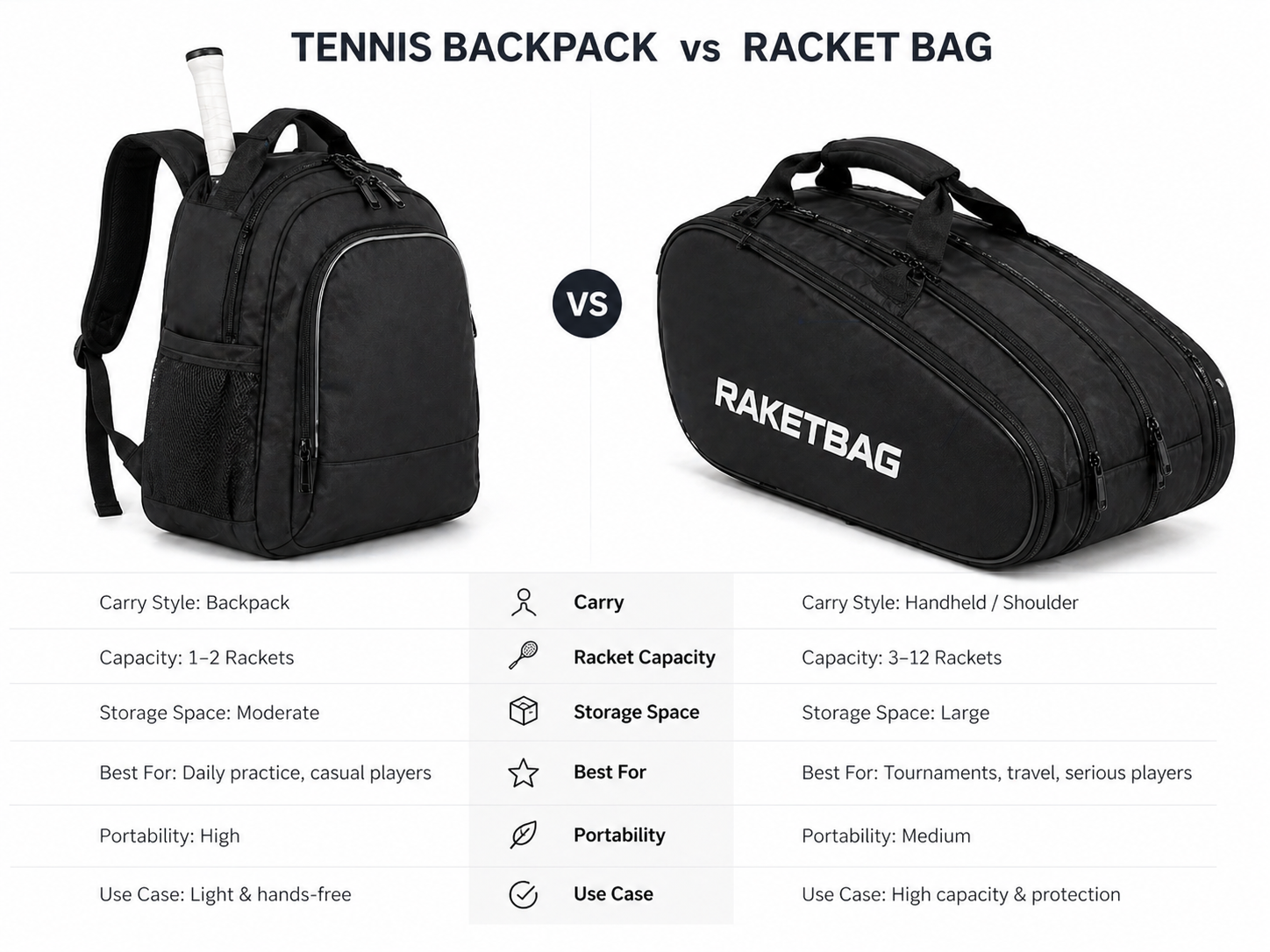
Clear differentiation between these two categories helps reduce customer confusion and improves product-market fit.
What Are the Structural Differences Between Tennis Backpacks and Racquet Bags?
Structural design defines how each product performs in real-world usage.
Tennis backpacks use compact, vertical layouts for mobility, while racquet bags use horizontal, multi-compartment structures for high-capacity storage and equipment protection.
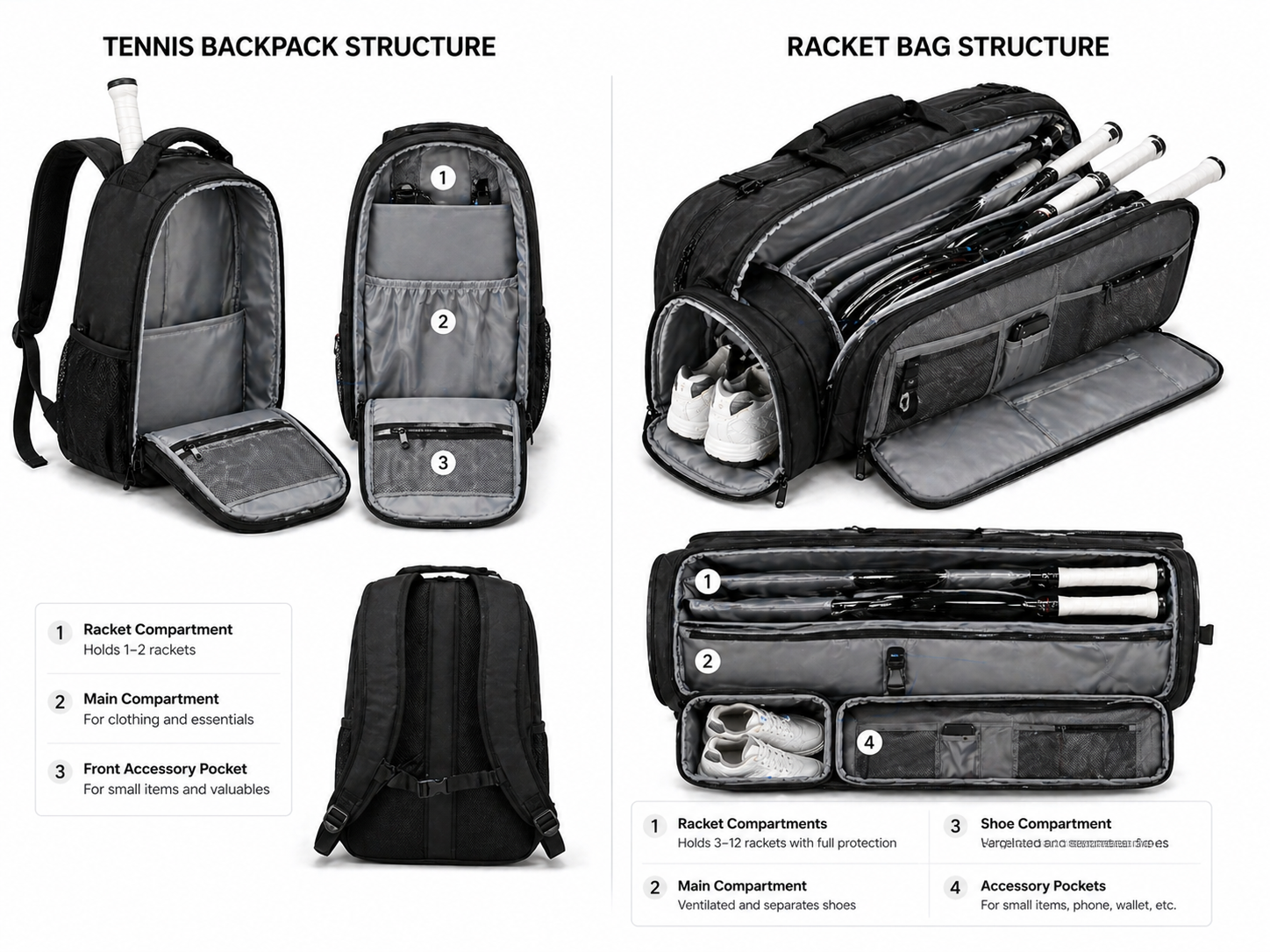
From an engineering perspective, the difference starts with load distribution and internal architecture. Tennis backpacks are designed for balanced, close-to-body carrying. They typically include a single main compartment, a dedicated racket sleeve, and limited auxiliary storage. This structure prioritizes mobility and convenience, especially in urban or casual playing environments.
In contrast, racquet bags are built around capacity and specialization. Their horizontal structure allows for multiple racket compartments, often separated by padding or thermal lining. These bags are designed to carry 3 to 9 rackets, along with shoes, clothing, and accessories, without compromising protection.
The distinction can be summarized clearly:
| Feature | Tennis Backpack | Racquet Bag |
|---|---|---|
| Structure | Vertical | Horizontal |
| Capacity | Low to medium | Medium to high |
| Usage | Daily / casual | Training / tournament |
| Compartments | Simplified | Specialized and segmented |
Another critical factor is structural reinforcement. Racquet bags require internal support systems to prevent collapse under heavy loads, while backpacks rely more on ergonomic shaping and lightweight materials.
Brands working with an experienced racket bag manufacturer can optimize these structural differences during development, ensuring each product type performs according to its intended use.
How Do Functional Differences Impact User Experience?
Functionality directly determines whether the product meets user expectations.
Backpacks focus on convenience and portability, while racquet bags emphasize storage efficiency, organization, and equipment protection.
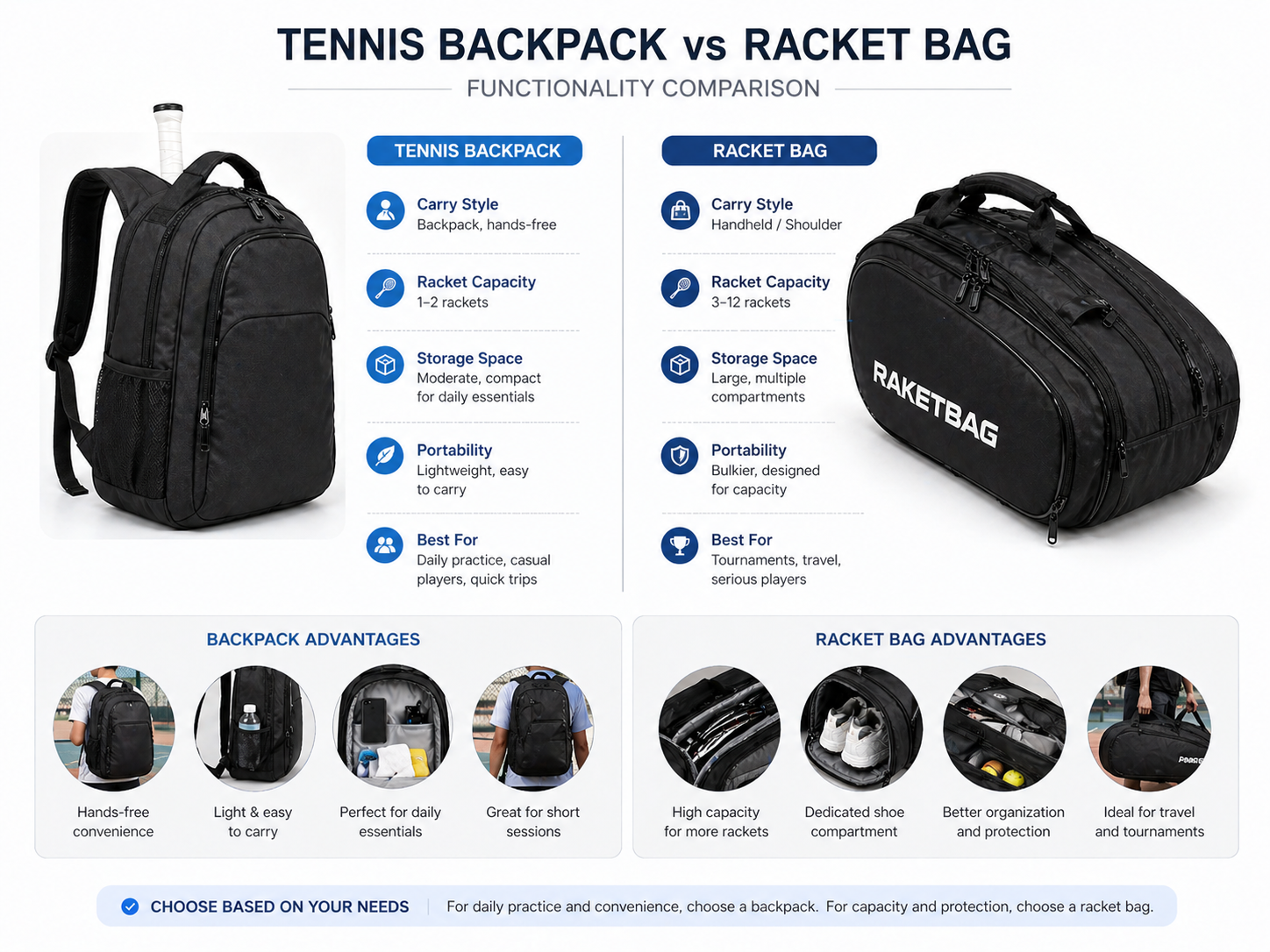
Tennis backpacks are designed for simplicity. They are ideal for players who carry fewer items and prioritize ease of movement. Features typically include quick-access pockets, lightweight construction, and ergonomic straps. However, limited capacity often leads to compromises, such as reduced space for shoes or lack of separation between clean and used items.
Racquet bags, on the other hand, are engineered for comprehensive storage. They include dedicated compartments for rackets, shoes, clothing, and accessories. Advanced designs may incorporate thermal lining to protect rackets from temperature changes, as well as reinforced shoe compartments to prevent deformation.
A key functional difference lies in organization. Poor compartment design is a common issue in lower-end products, leading to user complaints about items mixing together or lack of usable space. High-quality racquet bags address this through functional zoning and structural independence between compartments.
From a development standpoint, the challenge is balancing functionality with usability. Overcomplicated designs can reduce efficiency, while overly simple layouts limit versatility. Achieving the right balance requires deep understanding of user behavior and product testing in real scenarios.
What Does Market Demand Reveal About Backpacks vs Racquet Bags?
Market demand reflects how different user groups prioritize functionality and price.
Backpacks dominate the casual and entry-level segment, while racquet bags lead in professional and high-capacity categories. Both segments are growing, but serve different customer profiles.
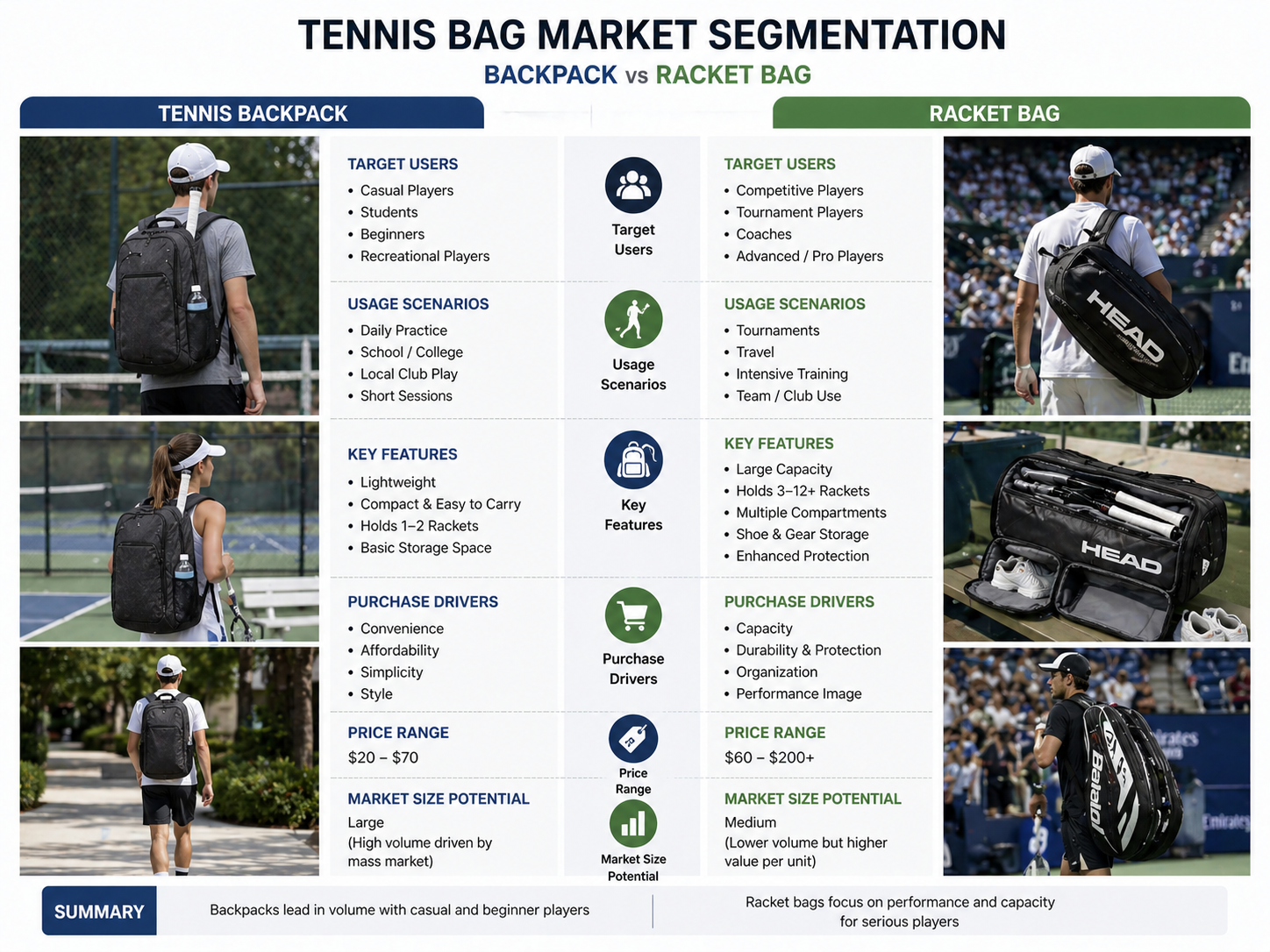
In recent years, the rise of urban sports lifestyles has driven demand for tennis backpacks. These products appeal to younger players, casual users, and consumers who value portability over capacity. Their lower price point also makes them accessible to a broader audience.
Racquet bags remain essential in the performance segment. Competitive players, coaches, and frequent users require higher capacity and better organization. These users are less price-sensitive and more focused on durability and functionality.
Market segmentation can be broadly understood as follows:
| Segment | Preferred Product | Key Driver |
|---|---|---|
| Entry-level players | Backpack | Price and convenience |
| Casual players | Backpack | Portability |
| Intermediate players | Both | Flexibility |
| Professional players | Racquet bag | Capacity and protection |
For brands, this segmentation creates opportunities to expand product lines across different price tiers and usage scenarios. A diversified offering reduces reliance on a single category and improves overall market coverage.
Collaborating with a reliable tennis bag supplier allows brands to develop both categories with consistent quality standards, ensuring alignment with different market segments.
How Should Brands Position Tennis Backpacks vs Traditional Racquet Bags?
Product positioning determines how effectively each category performs in the market.
Backpacks should be positioned as lifestyle-oriented, portable solutions, while racquet bags should emphasize performance, capacity, and professional use.
Successful brands differentiate these products not only through design but also through messaging. Tennis backpacks are often marketed with themes such as mobility, convenience, and urban lifestyle. Visuals typically show everyday use scenarios, including commuting or casual play.
Racquet bags, in contrast, are positioned as performance tools. Marketing focuses on features such as multi-racket capacity, thermal protection, and advanced compartment systems. These products are often associated with serious training and competitive play.
From a product development perspective, positioning must be supported by real functionality. Misalignment between marketing and actual performance leads to negative reviews and reduced brand trust.
Key positioning considerations include:
- Aligning product features with target user needs
- Differentiating design language between categories
- Maintaining consistent quality across price tiers
Brands that treat backpacks and racquet bags as distinct product lines—not variations of the same product—are better positioned to capture diverse market segments and build stronger brand identity.
Conclusion
Tennis backpacks and racquet bags serve fundamentally different purposes. Clear structural design, functional alignment, and precise market positioning enable brands to meet diverse user needs and strengthen competitiveness across multiple segments.