A tennis bag can look spacious in a product photograph and still be difficult to use. Load it with rackets, shoes, a change of clothes and a full water bottle, and the problems become easier to see: the shoe compartment pushes into the racket section, the opening catches the grips, or the shoulder straps pull the bag away from the body.
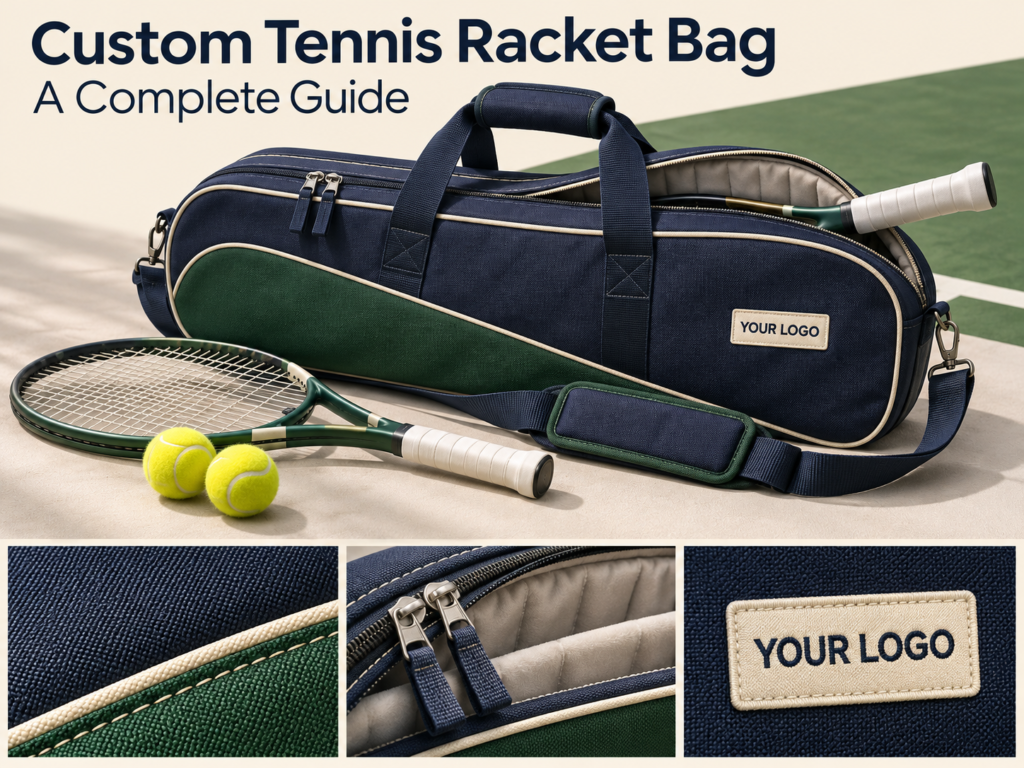
These details matter when developing a custom tennis racket bag. The logo gives the bag its identity, but the pattern, materials and construction determine whether players will want to carry it.
For clubs, academies, sports retailers and brands, the development process should begin with a clear understanding of how the bag will be used. This guide explains how to choose a suitable format, specify its construction and evaluate a sample before approving production.
Start With What Players Actually Carry
Before discussing fabric colors or logo placement, write down the intended packing list.
A player attending an evening training session may need two rackets, shoes, a towel and a bottle. A tournament player may also carry spare clothing, additional rackets, food, recovery equipment and several small accessories. Designing both bags around the same layout can leave one unnecessarily bulky and the other short of usable space.
A practical brief should establish:
- The number and size of rackets.
- Whether racket handles must be fully enclosed.
- The footwear size the bag must accommodate.
- The amount of clothing and other equipment.
- The size of bottles and ball containers.
- How the bag will normally be carried.
Be specific. “Space for two adult rackets, one pair of shoes, a change of clothes, two ball tubes and a bottle” gives a designer something measurable to work with. “A large tennis bag” does not.
The journey to the court matters as well. A bag carried on foot or public transport needs careful attention to balance and overall width. A bag used mainly between a car and a changing room may place greater emphasis on storage and convenient grab handles.
Choose a Bag Format That Fits the Use
The best format depends on the equipment load and carrying routine.
| Bag format | Suitable use | What to check |
|---|---|---|
| Tennis backpack | Daily practice, commuting and smaller equipment loads | Racket retention, handle position and loaded balance |
| Full-length racket bag | Multiple rackets and enclosed equipment storage | Internal clearance, compartment layout and zipper access |
| Tennis duffel | Clothing-heavy training days and team travel | Racket separation and protection |
| Tennis tote | Club use and lighter equipment loads | Closure security, handle clearance and racket stability |
| Junior tennis bag | Younger players carrying a smaller kit | Body fit, strap position and manageable loaded weight |
Tennis backpacks
A backpack is practical when players need their hands free. However, a racket pocket should do more than hold the frame while the bag is standing upright.
Check whether the racket moves when the wearer walks, bends down or takes the bag off one shoulder. If the handles remain exposed, confirm that they do not interfere with head movement.
Bottle pockets also need to be checked under load. A pocket that works on an empty sample may become too tight when the main compartment is full.
Full-length racket bags
Full-length bags provide enclosed storage, but external dimensions do not tell the whole story. Curved ends, padding, seam allowances and zipper placement reduce usable internal space.
Check the opening as well as the compartment itself. A racket may fit inside the bag but still be awkward to insert through a short or narrow opening.
Capacity descriptions such as “six-racket” or “nine-racket” also need clarification. Ask whether the stated capacity assumes that all major compartments are used for rackets, leaving less room for shoes and clothing.
Duffels and totes
Duffels can accommodate clothing and larger accessories well, but a general sports duffel does not automatically provide suitable racket protection. Decide whether rackets need a dedicated sleeve, a padded divider or a separate compartment.
For totes, review how the opening closes around the equipment and whether the handles remain comfortable when the bag is fully packed.
Understand Fabric Specifications
Polyester and nylon are both options for custom tennis bags. Neither material name, by itself, tells you how the finished bag will perform.
The same applies to denier.
Denier describes yarn linear density. It does not independently establish abrasion resistance, tear strength or service life. Weave, yarn quality, fabric weight, coating and finishing all contribute to the behavior of the finished material.
When comparing fabrics, request information covering:
- Fiber composition and weave.
- Fabric weight.
- Coating or backing.
- Color references and physical swatches.
- Relevant performance test results, where required.
- Cleaning instructions.
A higher denier number should not be treated as a complete quality specification.
Use reinforcement where it serves a purpose
Different parts of a tennis bag experience different types of wear. The base may repeatedly contact hard courts and changing-room floors, while an internal divider mainly needs to separate equipment without adding excessive bulk.
Using a heavier fabric throughout the entire bag can increase weight and cost without addressing the most vulnerable areas.
Review the base, lower corners, strap attachments and other high-contact areas individually. Reinforcement should respond to the expected use of each part.
Approve physical swatches
Fabric photographs are useful for an initial discussion, but they are poor tools for judging stiffness, surface texture and folding behavior.
A fabric that looks suitable on a screen may feel too rigid when assembled into a backpack. Another may have the right appearance but lack the structure needed for a large racket bag.
Approve the material in physical form before confirming the final specification.
Distinguish Water Resistance From Waterproof Construction
A water-resistant outer fabric does not establish that the finished tennis bag is waterproof.
Water may enter through zipper openings, stitched seams, ventilation holes and other construction details. A coated fabric can therefore resist water penetration while the assembled bag still allows moisture inside.
If rain protection is an important requirement, define the expected conditions. Occasional light rain during a short walk is different from prolonged exposure beside an outdoor court.
Agree on how the finished bag will be evaluated and use product descriptions that reflect the results. Avoid making a waterproof claim based only on the fabric supplier’s description.
Design Compartments Around Their Contents
The number of pockets is less useful than how those pockets work when the bag is full.
Each compartment should have a defined purpose, enough clearance for its contents and an opening that remains accessible during normal use.
Racket storage
Check the racket compartment with the actual frames intended for the bag. Include racket covers if players are expected to use them.
Review the contact points around the frame, throat and handle. Padding should be positioned where it helps protect the equipment, and internal dividers should prevent hard accessories from pressing directly against the rackets.
For designs carrying several rackets together, check that users can remove one without excessive pulling or pressure on the zipper.
Shoe storage
Specify the footwear size the shoe compartment must accommodate. Then test it with shoes inside and the rest of the bag packed.
A soft shoe tunnel often extends into the main storage cavity. That arrangement may be acceptable, but the remaining capacity must still meet the original brief.
A removable shoe pouch can provide more flexibility when players do not always carry a separate pair of court shoes.
Ventilation openings may help airflow, but they do not remove the need to empty and dry the compartment after use.
Damp clothing
Clarify what a “wet pocket” is expected to do.
A compartment that separates used clothing from clean items is different from one designed to contain moisture. A wipe-clean lining does not establish leak resistance, particularly where the lining has stitched seams.
Choose the construction and wording according to the intended function.
Small accessories
Keys, phones, overgrips and other small items should be easy to locate without unpacking the main compartment.
Pocket position matters. A valuables pocket that becomes inaccessible behind tightly packed clothing is of limited use. Check access after the sample has been loaded, rather than evaluating each pocket on an empty bag.
Assess Thermal Lining Carefully
An insulated racket compartment may slow heat transfer, but its performance depends on the complete construction and the conditions of use.
A reflective lining alone does not demonstrate that the compartment will maintain a particular temperature. Insulation coverage, closures, exposure time and ambient conditions all affect the outcome.
If temperature protection is part of the product specification, agree on a suitable test method and measurable acceptance criteria.
Avoid unsupported claims about preventing racket or string damage. An insulated bag should not be presented as a safe way to leave equipment in a hot vehicle.
Evaluate the Carry System Under Load
An empty sample tells you little about carrying comfort.
Load the bag with the intended equipment before checking shoulder straps, handles and balance.
For backpacks, review:
- The distance between the shoulder straps.
- The available adjustment range.
- How the back panel sits against the body.
- Whether the loaded bag pulls backward.
- Whether buckles or strap edges create pressure points.
Thicker padding will not correct an unsuitable strap position.
For shoulder-carry bags, check whether the shoulder pad stays in place and whether the bag twists while walking. Confirm that the strap adjusts far enough for the intended carrying position.
Junior bags require particular attention to fit. Simply reducing an adult bag’s dimensions does not establish that the strap geometry or loaded weight will suit younger players.
Inspect the attachment points
Handles and straps transfer the equipment load into the bag body. Their attachment points deserve close inspection.
Look beyond the visible outer stitching. Reinforcement needs to distribute the load into an appropriate area of the construction. Ask how the attachment is supported internally and agree on load or durability checks suited to the product’s intended use.
Choose a Branding Method That Suits the Construction
Logo application should be considered while the bag is being designed. Seams, padding, coatings and pocket placement can restrict the available decoration area.
| Branding method | Suitable applications | What to inspect on the sample |
|---|---|---|
| Embroidery | Crests, monograms and defined lettering | Legibility, puckering, backing and panel distortion |
| Screen printing | Bold graphics and defined spot colors | Coverage, adhesion and behavior when flexed |
| Heat-applied transfers | Detailed artwork on compatible materials | Edge adhesion, heat marks and coating compatibility |
| Sublimation | Large graphics on suitable polyester substrates | Color reproduction and material suitability |
| Sewn or molded patches | Distinctive badges and logo treatments | Attachment security, thickness and edge finish |
Embroidery can work well for a club crest, but small lettering and fine detail may need to be simplified. Dense stitching can also distort a lightweight panel if the construction and backing are unsuitable.
Printed graphics require compatible materials and an appropriate application process. Review the decoration on the actual production fabric rather than approving it only on a digital mockup.
For color-critical projects, approve physical fabric, thread and print samples. The same color reference can appear different across these materials.
Make placement measurable
Provide the finished logo dimensions and a placement drawing.
“Centered on the side” can be interpreted in several ways, particularly on a curved or asymmetrical panel. Measurements from a defined seam or panel edge give production a clearer reference.
If bags need individual names or numbers, confirm the spelling, capitalization, typeface and placement before production. Personalization also requires a reliable checking process so that the correct details are applied to each bag.
Prepare a Clear Brief for Sampling
A complete technical pack is helpful, but it is not always necessary to begin development. A clear brief can give the manufacturer enough information to propose materials and construction.
| Information | What to provide |
|---|---|
| Intended user | Player profile, age group and primary use |
| Packing requirements | Rackets, shoes, clothing, bottles and accessories |
| Bag format | Preferred style, carrying method and target dimensions |
| Layout | Compartment sketches and access requirements |
| Materials | Preferred fabrics, lining, padding and physical references |
| Branding | Vector artwork, dimensions, colors and placement |
| Order quantity | Estimated quantity per style and color |
| Target cost | Budget assumptions and quotation requirements |
| Delivery plan | Destination and required arrival date |
| Packaging | Labels, barcodes, individual packing and carton requirements |
Reference products can help explain a preferred shape or feature. Annotate what you want to retain or change instead of sending an image without explanation.
Separate essential requirements from preferences. For example, fitting two fully enclosed rackets may be essential, while the exact shape of an accessory pocket may remain open to development.
Use original artwork and confirm permission to reproduce club crests, sponsor marks and other protected designs.
Review the Physical Sample Before Production
A digital mockup can confirm the intended appearance. It cannot establish racket fit, carrying comfort or workmanship.
Review the sample in a consistent sequence.
1. Pack the complete equipment list
Use the intended rackets, footwear, clothing and accessories together. Check whether the bag closes without excessive pressure and whether internal dividers remain in position.
2. Test access
Remove and replace the items players use most often. Check whether opening one compartment requires moving equipment from another.
3. Carry the bag
Walk, turn, put the bag down and pick it up using each intended carrying method. Look for shifting contents, strap discomfort and awkward balance.
4. Operate the closures
Check zipper movement around corners and across curved panels. Look for caught lining, distorted openings and strain caused by the packed contents.
5. Inspect workmanship
Review seams, binding, exposed edges, reinforcement and hardware. Check for loose threads, uneven assembly and components that interfere with normal operation.
6. Verify branding and packaging
Confirm spelling, dimensions, placement and appearance on the assembled bag. Review labels, barcodes and packing instructions where they form part of the order.
7. Record approval and revisions
Identify the sample version and list any required changes precisely. “Improve the quality” is difficult to act on. “Increase the shoe opening to accommodate the approved footwear sample” gives development a clear task.
This practical review helps identify design problems. It does not replace agreed laboratory testing or production inspections.
Before releasing bulk production, retain an approved reference sample and its corresponding written specification. Record dimensions, tolerances, materials, components, decoration and any agreed inspection requirements.
Understand What Drives the Cost
Two tennis bags can look similar and carry different manufacturing costs. The difference may be hidden in the lining, padding, reinforcement, zipper specification or assembly work.
Common cost factors include:
- Pattern complexity and the number of separate panels.
- Fabric consumption and cutting efficiency.
- Compartment and lining construction.
- Padding and reinforcement.
- Zippers, buckles and other components.
- Decoration size, method and number of locations.
- Order quantity and color variations.
- Packaging requirements.
Compare quotations against the same specification. Otherwise, a lower price may reflect a different material or construction rather than a more competitive offer for the same product.
Confirm sample charges, artwork or tooling costs, packaging and shipping terms. Keep manufacturing time separate from transit time when planning an arrival date.
Minimum quantities and lead times should be confirmed for the actual design. Custom-dyed materials, special hardware and additional sample revisions can change the requirements.
Developing a Custom Tennis Bag With Raketbag
Raketbag offers OEM and ODM sports bag development, including custom tennis bags with options for materials, colors, logos and structure.
To begin a project, prepare your equipment list, preferred bag format, reference dimensions, logo files and estimated order quantity. Include the delivery destination and required arrival date so that development and shipping can be reviewed together.
Explore Raketbag’s custom tennis bag options and use the sample stage to settle the details that affect everyday use: racket fit, usable storage, access and carrying comfort.
A successful design should make sense when it is packed, carried and used at the court. Those are the conditions under which the finished bag earns its place in a player’s routine.
Frequently Asked Questions
Can I customize only the logo on a tennis bag?
Yes, where the selected design and decoration area are suitable. Adding branding to an existing model generally involves fewer development decisions than changing its dimensions or compartment structure. Confirm the available options for the chosen bag.
Is nylon better than polyester for a tennis racket bag?
Neither material name establishes a better finished product. Compare the specific fabric construction, weight, coating and relevant test results, together with how the material will be used in the bag.
Does a tennis bag need a separate shoe compartment?
A separate compartment is useful when players regularly carry court shoes. Check that it accommodates the intended footwear without reducing the remaining storage below your requirements. A removable pouch may suit a more flexible layout.
What files are needed for a custom logo?
Vector artwork, such as an AI, EPS, SVG or vector PDF file, is preferable where available. Include the intended dimensions, color references and placement. Embroidery and other processes may require additional production preparation.
Can one design suit both junior and adult players?
Some designs may work for both, but this should be verified through fit and packing checks. Bag height, strap position, racket size and loaded weight all need to suit the intended users.
What should be approved before bulk production?
Approve the physical sample and written specification together. Confirm materials, dimensions, layout, components, branding and packaging, and record tolerances, inspection requirements and any agreed revisions.