A gym duffel gets used in ways a fabric swatch never will. A pair of trainers presses against the bottom corner. A full bottle rolls into the sidewall when the bag is dropped on a bench. A wet towel sits against a pocket seam on the way home. By the time a wear mark or leak shows up, the point of failure may be a few millimetres from a panel that performed well in the lab.
That is why a good material brief starts with the bag in use. A commuter who carries gym kit and a laptop has a different problem from a team manager hauling gear across a sports hall. The commuter may need a light shell and a wet pocket that keeps moisture away from electronics. The team bag needs a base that can take repeated floor contact and carry handles that distribute the load into the body. For a manufacturer, those differences determine where to add material, which seams to move, and what to test before committing to production.
Start with the load, the floor and the wet gear
Capacity tells you how much the bag can hold by volume. Packed weight tells you what the handles, shoulder strap and base have to support. List the heaviest items the customer is likely to carry together and where those items will sit. Two duffels of the same capacity can load their seams very differently if one carries clothes and the other holds several pairs of shoes and full water bottles.
Then ask where the bag spends its time. Rubber gym flooring, rough concrete, vehicle cargo areas and wet locker-room tiles put different demands on a base. Look at how the bag rests when it is full and when it is half empty. A soft bag can collapse until the bottom side seam touches the floor. On the next sample, moving that seam up the sidewall may do more for wear life than increasing the weight of the entire shell.
Finally, define the moisture problem in plain terms. Should the bag handle a short walk in rain? Should it sit on a wet floor without soaking through the base? Should a pocket hold swimwear that is still dripping? Each requirement points to a different construction and a different sample test. Put the intended exposure in the product brief so that the buyer and factory are evaluating the same thing.
Specify the finished fabric behind the denier label
Denier describes yarn linear density. One denier equals one gram per 9,000 metres of yarn. A label such as 600D identifies a yarn size, while the weave, yarn properties, coating and finishing determine what the finished cloth feels like and how it performs. Two rolls of 600D polyester can have different finished weights, stiffness and tear resistance. They can also behave differently when folded into the same corner seam.
Ask for the mill’s fabric article code, fibre content, weave, finished weight in grams per square metre and usable width. Confirm which face is treated, what backing or film is applied, and what tolerances the mill can hold. For fabrics that will be compared on tear strength, request results in both the warp and weft directions. Keep the approved swatch with the written specification. The swatch is particularly useful for judging hand, surface texture and colour when a later roll carries the same description on its label.
Polyester for everyday training duffels
A PU-backed 600D woven polyester is a sensible first sample for a daily duffel that carries shoes, clothes and a bottle. It gives the development team a starting point for balancing structure, weight and price. Check the fabric where the design asks it to do the most work. Wrap it around the end of the bag, stitch it through the proposed reinforcement stack and run the zipper around the tightest curve. A fabric that feels right on the table can make the opening too stiff once the lining, binding and zipper tape are sewn in.
For a range with several colourways, check the actual shell against the webbing, zipper tape and lining. The components can look close under one light and visibly different under another. If a dark shell or lining will rub against light clothing, include a colour transfer check on the production-intent colourway. When sourcing recycled polyester, keep the performance criteria for the panel and obtain documentation for the recycled-content claim separately.
Nylon and ripstop for weight-sensitive designs
For a commuter gym bag that already has a padded sleeve, several pockets and substantial hardware, the shell is one place to recover weight. A 420D nylon or a lighter nylon ripstop is worth sampling. Ripstop uses reinforcement yarns in a grid to help limit the spread of a tear. Compare the finished weights and tear results of the specific fabrics on offer, then see how each carries once the sample is fully assembled. The reduction in shell weight can be small relative to the weight of a thick base board, a large buckle or an overbuilt strap.
Look closely at how a lighter shell behaves around stitch lines. Fill the bag to its intended load and watch the fabric next to the carry points. A narrow reinforcement can leave a concentrated pull along its edge. A wider backing patch, or a strap attachment that extends into a structural seam, can distribute the load over more fabric. Make that decision on a loaded prototype, where the direction of pull is visible.
Cotton canvas for a different hand and appearance
Cotton canvas can suit a studio or lifestyle gym bag where the buyer wants a matte surface, a softer hand or a particular print finish. Canvas describes the construction, so the purchase specification should also identify the fibre. Cotton can take up moisture, which affects drying after contact with wet floors or towels. A coated base and a removable wet pouch can give a canvas bag more flexibility for daily use. Check how the shell looks after it has been rubbed and spot-cleaned, especially on light colours and around handles.
Build the base and carry points as a system
The highest-wear panel rarely needs to cover the whole bag. A denser woven fabric or a coated fabric at the base can protect the floor-contact area while keeping the sides easier to fold. Draw the base panel up around the corners far enough to move its joining seam out of direct contact with the ground. Check that placement with the bag packed. The contact area can shift when shoes push the panel outward or when the duffel is lifted by one end and dragged briefly.
Treat the webbing, reinforcement, thread and body fabric as one assembly at each carry point. A heavily stitched strap can remain intact while the shell tears along the edge of the stitching. If a sample shows puckering, stitch-hole elongation or a seam starting to open, follow the pull into the surrounding panel. The fix may be a larger backing patch, a change in the stitch layout or a longer webbing attachment. Repeat the same loaded check after the change so you can see whether the stress moved to another edge.
Zippers and lining need the same attention. A shoe tunnel that extends into the main compartment can push against the opening when both spaces are full. A lining that hangs loose near the zipper can get caught in the slider. Check the bag with the actual shoe size and bottle shape specified in the brief. Try opening it on a bench and while it hangs from a shoulder strap. Those two positions can expose different problems with access and slider movement.
Choose a water-resistant construction for the exposure
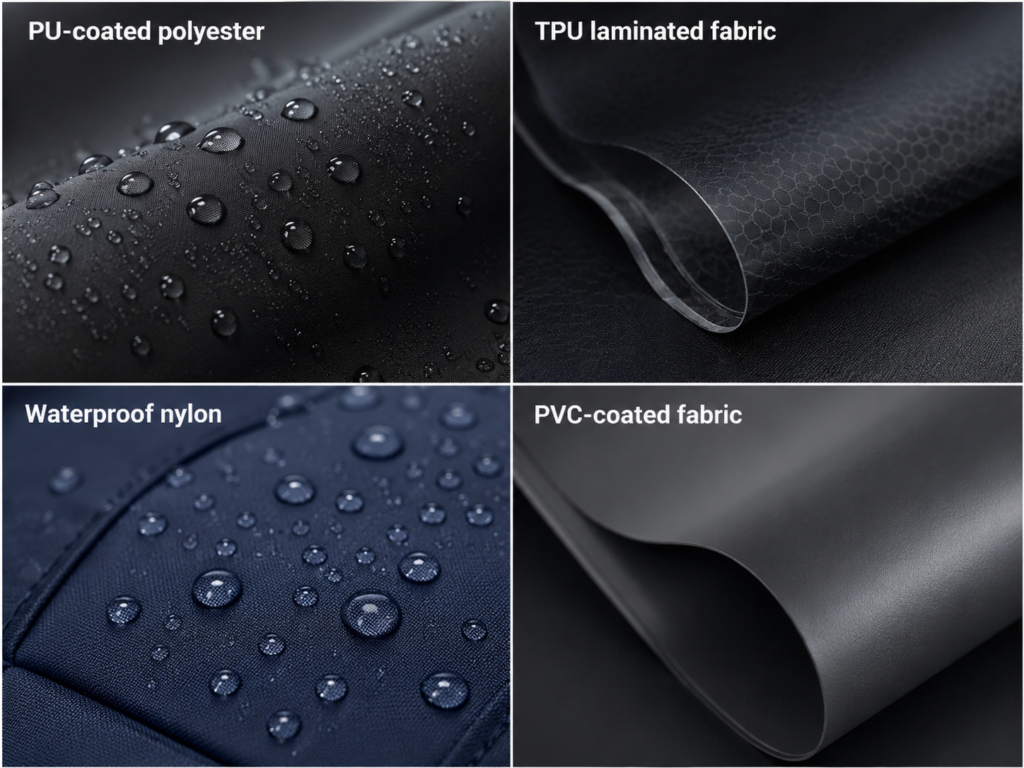
A water-repellent finish on the face helps droplets bead. A PU coating on the back or a thermoplastic polyurethane (TPU) film laminated to the fabric can increase the fabric’s resistance to water penetration. The seam, zipper and closure still determine how water moves through the assembled bag. A splash can enter through a zipper end, and water can collect against a bottom seam even when the surrounding cloth sheds droplets easily.
For a daily duffel expected to see light rain, pay attention to opening orientation and the ends of the zipper. Test the bag in the carrying position that exposes the top opening. For a bag that will sit on damp tile, put the assembled sample on the wetted surface and inspect the inside at the corners and along the base seam. Set the exposure time and the acceptable amount of moisture before the test so that sample approval is repeatable.
If the brief calls for containing wet swimwear, a separate pouch made from a weld-compatible laminate is one option. Ask the supplier to confirm the material and joining process as a pair. A film that welds well on a flat strip still needs to be checked at folds, seam junctions and closure ends. Heavier coated constructions, including some PVC-coated fabrics, may be candidates for a wipe-clean base or welded compartment. Compare the actual samples for weight, flexibility, surface feel and weld performance before deciding where to use them.
Give shoes and wet clothing different compartments
A shoe compartment is usually designed for dirt control, access and airflow. Use a lining that can be wiped down and give the user enough access to reach the toe end of the pocket. Keep any vent above the area that rests on a wet floor. Test access while the main compartment is full. On a flat sample table, a pocket can look generous until the contents above it compress the opening.
A wet compartment has a different job. If it is intended for damp clothes after a short commute, a coated lining may be adequate once the seams and closure are checked under that exposure. If the pocket is expected to hold a soaked towel or swimwear that drips, test for leakage with the pouch on its side as well as upright. Put dry absorbent material in the adjacent compartment to help locate small leaks. Wetness along a long seam, at a seam junction or at a zipper end points to different changes in construction.
A removable pouch can make it easier to empty, wipe and air out a bag that goes from pool to office. A fixed compartment can be easier to reach without unpacking the bag. In either layout, check how much space the compartment takes from the main cavity once it is filled. This is especially important when the bag also has a padded laptop sleeve or a stiff shoe compartment.
Material combinations to sample
| Product brief | Shell and base | Interior construction | First sample check |
|---|---|---|---|
| Everyday training duffel | PU-backed 600D polyester shell with a base panel that wraps the corners | Woven polyester lining and a wipe-clean shoe pocket | Loaded corner wear and zipper movement with both compartments filled |
| Lightweight commuter gym bag | 420D nylon or lightweight nylon ripstop with reinforcement at floor-contact and carry points | Lightweight lining and a separate pocket for damp clothing | Finished weight and fabric distortion around the shoulder-strap anchors |
| Heavy-use team kit bag | Dense woven nylon or polyester with a heavier base and backed webbing attachments | Simple lined cavity with room for bulky gear | Repeated lifts at the intended packed weight and wear at the actual floor-contact points |
| Gym-to-pool duffel | Coated woven shell with a base designed for wet benches and floors | Separate wet pouch with a compatible film, seam and closure construction | Leakage into the main cavity with the pouch upright and on its side |
| Studio or lifestyle gym bag | Cotton canvas shell with a coated base panel where the bag contacts the floor | Woven lining with a removable pouch for damp items | Colour transfer, spot-cleaning appearance and moisture entry through the base |
These are starting points for sourcing and sampling. The actual fabric should be selected by article code, confirmed against the finished bag’s target weight and priced with the proposed construction. A heavier material on a small base panel can make sense. The same fabric across the whole bag can add weight, increase seam bulk and change how the top opening folds.
Verify fabric properties and finished-bag performance
Use laboratory results to compare material candidates under the same method and conditions. Use a packed prototype to confirm that the construction works with those materials. In particular, report abrasion results with the abradant, applied load and endpoint. One result may count cycles to a visible change, while another counts cycles to a hole. A cycle count needs that context to support a purchasing decision.
| Property or risk | Material-level check | Finished-bag check |
|---|---|---|
| Surface abrasion | Use a consistent method and report the abradant, load and endpoint. ASTM D3884 describes a rotary platform abrader method for textile fabrics. | Check the loaded bottom corners, edges and exposed seam lines. |
| Tear and coating adhesion | Choose a procedure suited to the construction. ASTM D751 includes tear and coating-adhesion procedures for coated fabrics. | Look for tearing or distortion near strap patches and around folded panels. |
| Surface wetting and water penetration | ISO 4920 assesses surface wetting by spray. ISO 811 assesses resistance to water penetration under hydrostatic pressure. | Use the intended exposure and check entry through the base, seams and closure. |
| Colour transfer | ISO 105-X12 measures resistance to colour rubbing off onto another material. | Inspect contact with light apparel and adjacent panels, especially for dark colourways. |
| Carry points and closures | Confirm the webbing, thread, hardware and zipper specifications. | Cycle the handles and strap at the specified packed weight, then run the zipper with the bag full. |
Set the pass criteria before approving the prototype. Specify the packed weight, how the load is arranged, the number of cycles and what counts as a failure. For instance, a buyer may want to track visible seam opening and permanent distortion at a strap anchor as separate observations. Record where the change occurs and photograph it under load if the movement disappears when the bag is empty. A cycle count is much more useful when the next sample can be checked under the same conditions.
For the test methods, see ASTM D3884, ASTM D751, ISO 4920, ISO 811 and ISO 105-X12.
Carry the sample specification into bulk production
An approved development sample is easiest to reproduce when the records identify the actual components. Put the shell, base, lining and pocket fabrics on the bill of materials with their article codes and finish details. Add the zipper, sliders, webbing, thread and hardware. Show the base seam position and reinforcement placement in the construction drawing. Keep approved swatches and a signed pre-production sample so the team has something physical to compare with incoming material and the first units off the line.
Check incoming fabric for colour, usable width, weight and obvious defects against the approved specification. On the first production units, pay particular attention to details that were revised during sampling. If the base seam was moved to clear the floor, check its location on the packed bag. If the wet-pocket closure was changed to reduce leakage, run the agreed exposure test on the production construction. Small differences in seam allowance or closure placement can matter even when the materials are identical.
Handle substitutions at the panel level. If the original base fabric becomes unavailable, compare the replacement’s abrasion results, weight and fold behaviour, then sew and check the affected corner before approving the change. For a shell substitution, check the carry attachments and zipper opening as well. Both fabrics might be described as PU-backed 600D polyester, but a thicker backing or stiffer weave can change the way the bag goes together. Document the decision with the replacement article code and update the approved sample or swatch record.
Develop a custom gym bag with Raketbag
When you brief Raketbag on an OEM or ODM gym bag, share the target capacity, intended packed weight, price range and the conditions the bag will see. Include the largest shoe size or equipment dimensions if they affect pocket access. Describe what the wet compartment needs to hold and how the bag will be carried. Those details let the development team compare material combinations, decide where reinforcement is worth the weight, and agree on the sample checks before the production materials are ordered.