Choosing a sports bag manufacturer involves more than comparing prices, fabric options, and logo samples. Your supplier must translate a product concept into a bag that performs reliably, fits your market, and can be reproduced consistently.
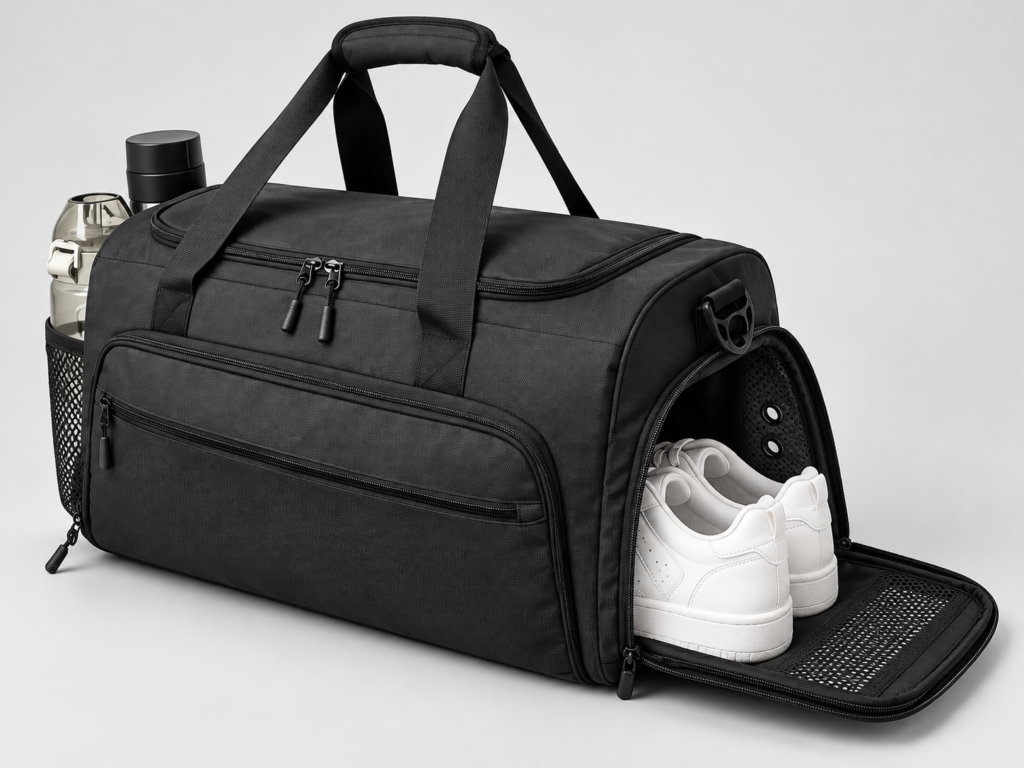
A gym duffel, racket bag, team equipment bag, and training backpack each present different construction challenges. The right manufacturing partner should understand these differences and explain how materials, reinforcement, compartments, and production methods support your requirements.
This guide outlines how to evaluate manufacturers, compare quotations, approve samples, and establish quality standards before placing a commercial order.
Define the Product Before Comparing Suppliers
A clear product brief makes supplier selection more objective. Without one, factories may quote different materials and constructions, making apparently similar prices difficult to compare.
Start by defining:
| Requirement | Details to Establish |
|---|---|
| Intended user | Recreational athletes, competitive players, teams, or travelers |
| Use conditions | Daily commuting, gym use, outdoor training, or equipment transport |
| Carrying requirements | Contents, expected load, and carrying duration |
| Organization | Main compartment, footwear storage, valuables pocket, and equipment sections |
| Product positioning | Target retail price, appearance, and warranty expectations |
| Commercial scope | Quantity per model and color, packaging, and delivery destination |
For example, a bag intended to carry shoes, damp clothing, and a laptop needs more than three labeled compartments. It requires a layout that separates those contents without making access awkward or allowing moisture to reach sensitive items.
Specify what the bag must do before deciding how it should look.
Look for Experience With Your Bag Category
General sewing capability does not automatically establish expertise in technical sports bags.
Ask to see products with construction requirements similar to yours. A manufacturer experienced in lightweight promotional totes may need additional development support for a structured backpack or a heavily loaded team equipment bag.
Review examples for functional details:
- How are shoulder straps connected to the body?
- How is the base reinforced?
- Can users access compartments when the bag is fully packed?
- Are internal dividers supported or likely to collapse?
- Are zippers positioned away from excessive strain?
Ask which operations are completed in-house and which are outsourced. External printing, embroidery, or specialist material processing can be workable, provided responsibilities and inspection procedures are clear.
Evaluate Materials Beyond Their Marketing Names

Descriptions such as “premium polyester,” “heavy-duty nylon,” or “waterproof fabric” are not complete purchasing specifications.
For the main fabric, confirm the fiber composition, yarn specification, fabric weight, construction, backing, and finish. Assess lining, mesh, foam, webbing, and binding separately rather than assuming the outer fabric determines the entire bag’s quality.
Denier describes yarn linear density; it should not be used alone to rank finished-fabric durability. Fabric construction, fiber properties, coatings, and reinforcement all deserve evaluation.
Water Resistance Requires a Complete-System View
A water-resistant outer fabric does not make the finished bag waterproof. Seams, zipper openings, stitching holes, and compartment construction can provide entry points.
Even specialist water-repellent zippers may not be waterproof or watertight. YKK explicitly makes this distinction for its AquaGuard range.
Define the intended protection level and agree on an appropriate test method before using a waterproof claim.
Inspect Construction at High-Stress Areas
Sports bags experience repeated lifting, pulling, overpacking, and contact with floors. Construction quality is particularly important where those forces concentrate.
Handles and Shoulder Straps
Check how loads transfer from the handle or strap into the bag body. Reinforcement should support the intended load without creating a weak point immediately beside the reinforced area.
Box stitching and bar tacks can be useful, but their presence alone does not establish strength. Thread, fabric, stitch placement, seam allowance, and backing must work together.
Zippers and Openings
Evaluate zipper size, slider operation, end stops, and attachment quality. A large opening improves access only if the surrounding structure remains stable.
Test the bag when loaded. Zippers that move smoothly on an empty sample may become difficult to operate when compartments are packed tightly.
Base and Internal Dividers
The base should suit the product’s weight and contact conditions. Internal panels and pockets should remain usable without placing concentrated pressure on nearby seams or carried equipment.
Understand the Available Customization
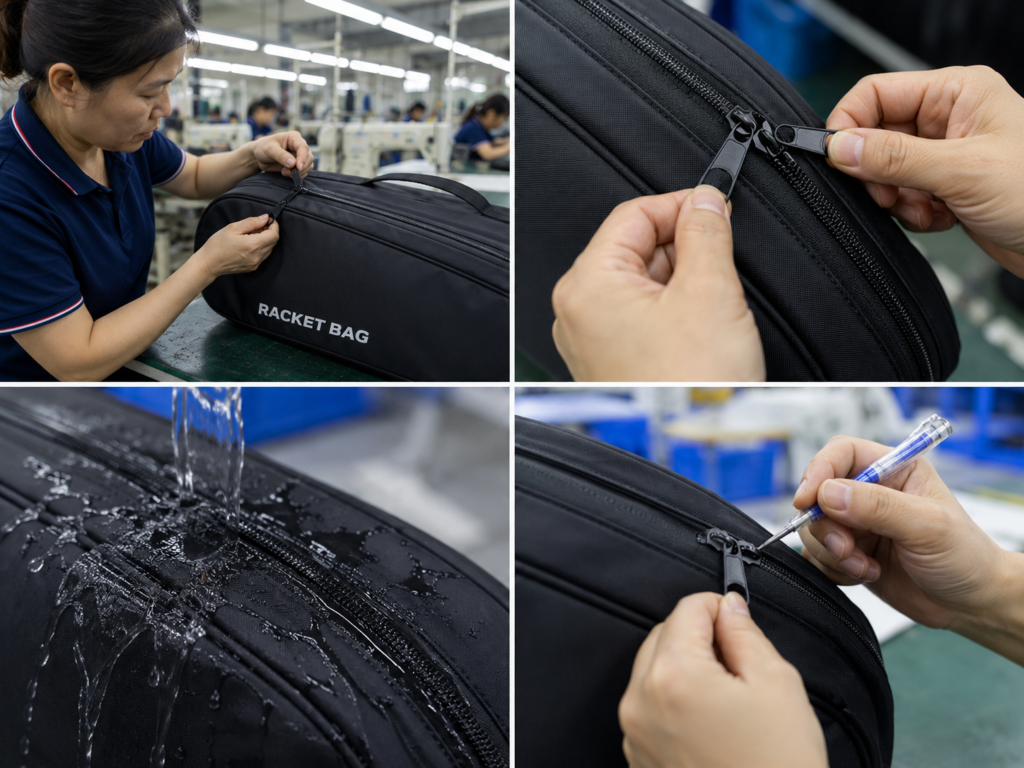
OEM and ODM terminology varies between suppliers. Establish the actual development scope rather than relying on the label.
| Project Scope | Typical Work Involved |
|---|---|
| Branding an existing design | Logo application, selected colors, and labels |
| Modifying an existing platform | Pocket changes, material substitutions, or revised dimensions |
| Developing a new bag | Pattern development, structural trials, and multiple sample revisions |
Confirm who owns custom patterns and artwork, whether exclusivity is available, and how development charges are handled.
A manufacturer should explain how a requested change affects cost, weight, function, and production—not simply agree to every modification.
Use Sampling to Validate the Product
A sample should answer specific development questions.
An initial prototype may establish dimensions and layout. A later sample should confirm the intended materials, construction, graphics, and workmanship. Before production, approve a representative reference sample with a written specification.
Evaluate the sample under realistic conditions:
- Pack it with the intended contents.
- Check access, organization, and balance.
- Assess carrying comfort at the intended load.
- Operate closures and adjustment systems repeatedly.
- Inspect seams and attachment points after use.
Do not rely exclusively on photographs. They cannot establish fabric feel, zipper resistance, compartment accessibility, or carrying comfort.
Record revisions clearly so the factory knows which version is approved.
Establish Measurable Quality Requirements
“Same quality as the sample” is useful as a visual reference but insufficient as the entire quality agreement.
Document dimensions, tolerances, materials, colors, branding positions, and workmanship criteria. For performance requirements, specify the test method, loading conditions, duration or cycles, and acceptance criteria.
Depending on the product, testing may cover seam and attachment strength, static and dynamic loading, abrasion, zipper operation, and colorfastness. These should be selected according to the bag’s intended use rather than applied as a generic checklist. QIMA identifies material, seam, strap, and load testing among relevant luggage evaluations.
Quality checks should also occur during production. Incoming-material verification and in-process inspections help identify problems before every unit is finished. Bag and luggage inspection programs can include initial, during-production, pre-shipment, and loading checks.
If statistical acceptance sampling is used, agree on the sampling plan and defect classifications. Sampling does not establish that every item in the shipment is defect-free.
Compare Quotes on the Same Basis
The lowest unit price may exclude features or services included elsewhere.
Ask every shortlisted supplier to quote against the same specification and identify exclusions.
Compare:
- Main fabric, lining, reinforcement, and hardware
- Logo methods and number of artwork variations
- Sample, pattern, and tooling charges
- Packaging and labeling
- Inspection and testing responsibilities
- Order quantity per style and color
- Delivery terms and named location
Consider total landed cost alongside factory price. Freight, packaging volume, inspection, and potential rework can materially affect the commercial result.
Cost reduction is most useful when it removes unnecessary complexity without compromising the bag’s essential function.
Confirm MOQ and Production Timelines
There is no universal minimum order quantity for custom sports bags. The practical minimum depends on fabric purchasing, custom dyeing, hardware availability, branding setup, and production planning.
Ask whether the MOQ applies per style, color, or total order. Custom packaging or accessories may carry separate minimums.
Likewise, separate the timeline into material sourcing, sampling, approval, production, inspection, and shipping. Confirm when the production clock starts and which decisions must be completed beforehand.
A short lead time may be realistic for an existing design using available materials. A new structure with custom fabrics and hardware requires a different schedule.
Assess Communication and Change Control
A capable supplier should identify uncertainty early, explain technical trade-offs, and document decisions.
Before production, agree that changes to materials, hardware, dimensions, or construction require review. Substituting a fabric that looks similar can still change stiffness, weight, sewing behavior, and durability.
For repeat orders, retain the approved specification, material references, and production records. Consistency becomes easier to manage when both parties work from the same controlled information.
Warning Signs to Investigate
Be cautious when a supplier cannot explain its material specifications, avoids discussing sample discrepancies, or repeatedly changes quotations without identifying the reason.
Other concerns include unsupported performance claims, unclear subcontracting arrangements, and refusal to document acceptance criteria or defect-resolution procedures.
A supplier’s location, low MOQ, or broad catalog is not enough to determine reliability. Evaluate evidence of capability and the quality of its responses to your actual project.
Conclusion
The right sports bag manufacturer can turn a clear brief into a functional sample and reproduce that design consistently. Evaluate category experience, material knowledge, construction quality, sampling, and production control alongside price.
Begin with a defined specification, test the bag under realistic conditions, and approve measurable requirements before placing a bulk order. This provides a stronger foundation for dependable products, fewer avoidable discrepancies, and a lasting manufacturing partnership.