Internal and external frame backpacks differ in how their support structure integrates with the bag. Internal frames sit within the pack and generally support a compact profile. External frames carry the packbag on an exposed structure that may also accommodate separately secured equipment.
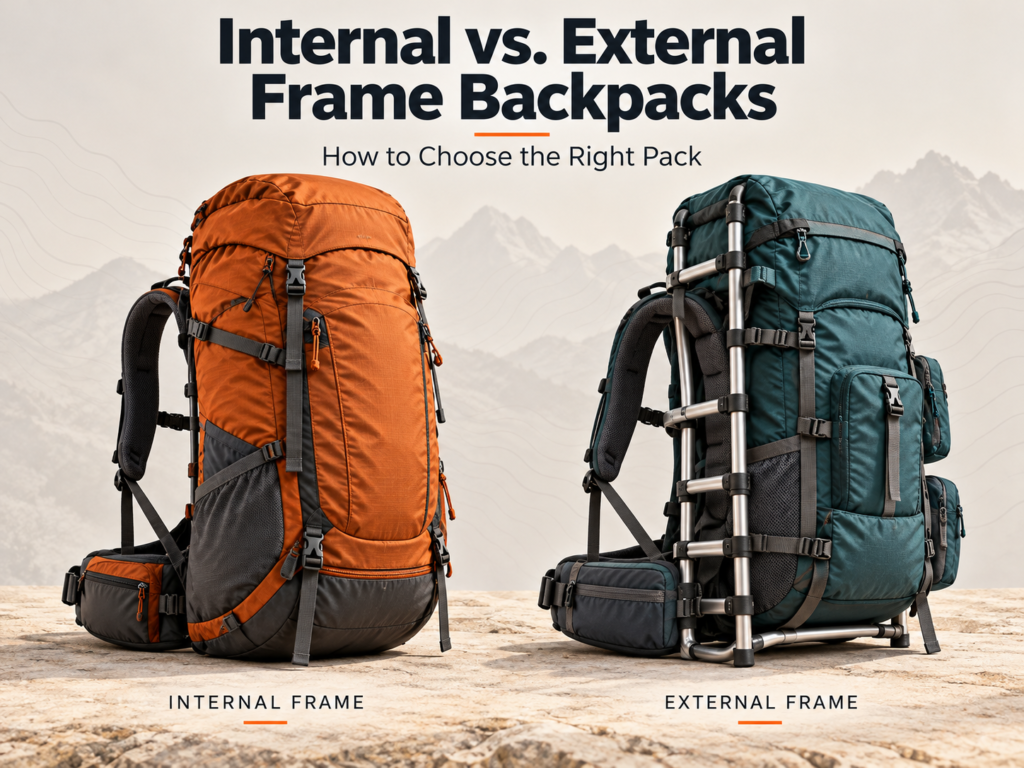
The choice depends on the load, terrain, and fit—not simply whether the frame is visible. Internal frame designs commonly suit conventional backpacking loads and close-fitting movement, while external systems can be useful for bulky cargo or specialized hauling.
This guide compares their construction, carrying characteristics, ventilation, and equipment-carry options. It explains what to evaluate so you can choose a pack suited to your actual gear and route.
Internal and External Frames: Key Differences
Frame position influences a backpack’s profile, load attachment, and carrying characteristics. However, fit and performance depend on the complete system—including the harness, hip belt, frame geometry, and packing arrangement.
| Feature | Internal Frame | External Frame |
|---|---|---|
| Support structure | Integrated into the packbody or back-panel assembly | Positioned outside the packbag |
| Overall profile | Generally compact and closely integrated | May extend beyond the bag to support attached cargo |
| Movement clearance | Often convenient for narrow trails and dynamic movement | Exposed sections or attached loads may require more clearance |
| Equipment attachment | Uses internal storage and designated external attachments | May offer a platform for separately secured or irregular cargo |
| Ventilation | Depends on back-panel design; some use suspended mesh | Some designs provide a substantial gap behind the wearer |
| Typical applications | Backpacking, trekking, and selected technical activities | Specialized hauling and trips involving bulky equipment |
| Main evaluation priority | Fit, stability, and support at the intended load | Load retention, frame clearance, and carrying balance |
These are design tendencies rather than guarantees. An internal frame is not automatically more comfortable, and an external frame does not automatically carry a heavier load safely.
Understanding Internal Frame Backpacks
An internal frame is housed within the backpack’s structure. Depending on the model, it may combine metal stays, a framesheet, or a perimeter frame with padding and a carrying harness.
The support system helps maintain the pack’s shape and distribute weight through its connection to the shoulder straps and hip belt. Effective load transfer depends on correct sizing, adjustment, and structural integration—not simply the presence of metal stays.
Why the Integrated Profile Matters
Keeping the frame and bag closely integrated can make the pack easier to manage when turning, stepping over obstacles, or moving through confined terrain. Actual stability still depends on where the contents sit and how effectively compression straps control them.
Internal frames appear in trekking, backpacking, and mountaineering designs. The term identifies a construction approach, not an intended activity. Equipment attachments, helmet clearance, ventilation, and load capacity must be evaluated separately.
Understanding External Frame Backpacks
An external frame supports the packbag from outside, with the harness and hip belt connected to the frame assembly. Designs vary in material, dimensions, and the way the bag or cargo attaches.
Some systems provide an extended platform for equipment that does not fit conventional compartments. This can be useful for specialized hauling, provided the frame, attachment points, and load restraints are designed for that purpose.
Consider Clearance and Load Position
The exposed structure can create space behind the back, but ventilation depends on the actual frame and harness arrangement.
Frame extensions and externally secured equipment also increase the space needed to move through vegetation or narrow passages. An uneven or poorly restrained load can undermine carrying stability regardless of frame strength.
Assess the complete loaded configuration: confirm that the cargo remains secure, the pack fits properly, and the frame allows the movement required by the route.
Comfort Depends on Fit and Suspension
Internal and external frames can both support effective load carrying. Comfort depends on how the frame, shoulder harness, and hip belt work together—and whether that system fits the wearer.
Compare backpacks with representative contents rather than judging them empty. Include externally carried equipment, as its position can change balance and pressure.
During a loaded fitting, check:
- Torso length and hip-belt sizing
- Secure, comfortable contact around the hips
- Shoulder-strap shape and pressure distribution
- Load movement when walking and changing direction
- Access to adjustments while wearing the pack
- The model’s recommended carrying range, where provided
A substantial frame cannot compensate for poor fit. Equally, generous padding does not guarantee effective support if the belt slips or the load pulls away from the body.
For a custom backpack project with raketbag, define the intended carrying load and user size range before selecting the frame and suspension.
Stability on Uneven Terrain
A closely integrated pack can help limit load movement during stepping, turning, and scrambling. Internal frame designs often support this arrangement, but stability also depends on packing, compression, and the shape of the loaded bag.
External frames can carry equipment securely when the cargo is positioned and restrained appropriately. However, bulky items placed far from the wearer may increase leverage and make changes in direction more demanding.
Evaluate the loaded configuration rather than assuming one frame type is always more stable. Test controlled movements such as stepping onto a low platform, bending, and turning. Check for shifting contents, belt movement, and interference from protruding equipment.
A brief walk on level ground may reveal pressure points, but it will not fully demonstrate handling on a demanding route.
Ventilation: Compare the Back System
Some external frame designs leave an open gap between the packbag and the wearer. Internal frame backpacks may also provide ventilation through suspended mesh or channels in the padding.
| Back-System Design | How It Supports Airflow | What to Assess |
|---|---|---|
| Suspended mesh | Separates the packbody from the contact panel | Air-gap retention, fit, and loaded stability |
| Channeled padding | Creates spaces between padded contact areas | Channel layout and compression under load |
| Stand-off frame arrangement | Holds the bag away from the wearer | Contact points, clearance, and load position |
Suspended mesh describes a back-panel arrangement, not a separate frame category. A visible perimeter rod does not automatically make a backpack an external frame model.
For warm-weather use, assess ventilation alongside support and balance. With raketbag, include climate, clothing layers, intended load, and back-system preferences in the development brief so these requirements can be evaluated together.
Comparing Weight and Durability
Neither internal nor external frames are inherently lighter or longer-lasting. Finished weight depends on the frame, fabric, padding, hardware, and accessories. Compare models with similar capacity and carrying requirements rather than selecting the lowest empty weight alone.
Durability depends on the complete load path—from the packbag and attachment points through the frame to the harness and hip belt. Inspect areas where repeated movement or concentrated forces may cause wear.
| Inspection Area | What to Check |
|---|---|
| Frame structure | Deformation, damaged surfaces, and insecure connections |
| Internal supports | Stay retention, framesheet positioning, and wear around pockets or sleeves |
| External frame connections | Joint movement, fastener security, and bag-to-frame attachments |
| Harness and hip belt | Stitching, webbing, adjustment hardware, and attachment reinforcement |
| Cargo restraints | Strap slippage, abrasion, and movement under representative loading |
Visual checks can identify concerns, but repeat-loading and functional tests provide a stronger basis for assessing reliability.
Choosing a Frame for Your Equipment and Route
An internal frame is a practical starting point for conventional backpacking equipment, especially where a compact profile and freedom of movement are priorities.
An external frame may suit specialized hauling when equipment is bulky, irregular, or carried separately from the packbag. Confirm that the specific frame and attachment system are designed for the proposed cargo.
Before deciding, evaluate a loaded sample:
- Adjust the torso fit, shoulder straps, and hip belt.
- Walk, turn, bend, and step onto a low platform.
- Check for shifting contents and swinging external equipment.
- Reassess pressure points and adjustment stability after walking.
- Confirm that openings and essential equipment remain accessible.
Choose capacity from the equipment list, then verify that the suspension can comfortably support the resulting load. Storage volume and carrying capability are separate requirements.
What Brands Should Specify Before Sampling
For product development, the frame category is only one part of the brief. Define the intended carrying conditions and user requirements before selecting materials or support components.
Include:
- Intended activity, terrain, and climate
- Usable capacity and target carrying load
- User torso range and hip-belt sizing
- Frame geometry, material, and removable components
- Bag-to-frame and harness attachment methods
- External equipment dimensions and retention requirements
- Ventilation, access, and packing priorities
- Finished-weight targets and agreed validation procedures
For detachable or adjustable systems, evaluate repeated assembly, adjustment, and loading. Confirm that components remain secure and that wear does not compromise their connection.
Discuss Your Backpack Project With raketbag
For a framed backpack project, share your product brief with raketbag to discuss the proposed construction, customization scope, and sampling requirements.
Frame selection should follow the equipment, load, and movement the pack must accommodate. Validate that choice through representative samples, then document the approved structure and inspection requirements before production.