A 600D polyester gym bag can weigh more, feel stiffer and be harder to zip than another bag made from 600D polyester. The two fabrics may use the same nominal yarn size, while differences in weave, coating and backing change how they behave once sewn. That is why a fabric brief that says only “600D polyester, black, water resistant” can produce two very different samples.
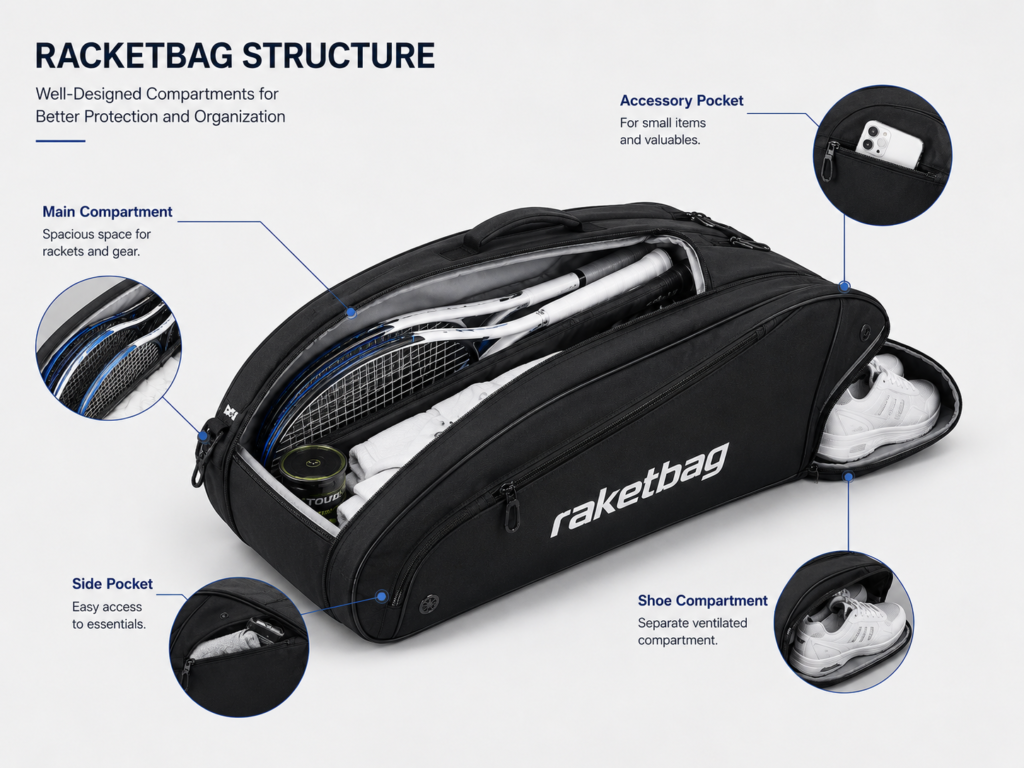
Start with the equipment the bag will carry and the surfaces it will encounter. A team duffel that gets set down on concrete needs attention at the base and lower corners. A gym bag that carries wet shoes needs a lining that can be wiped clean without turning the pocket inside out. A tennis racket bag needs a padded compartment with enough clearance for the frame to pass through the opening. These requirements tell you where to use heavier fabric, where to add padding and where a lighter material will do the job.
At Raketbag, we help brands turn those requirements into a material specification for sampling and bulk production. The decisions below apply whether you are developing a new sports bag or revising an existing model that is too heavy, wears prematurely or is difficult to clean. Raketbag custom sports bag manufacturing services.
Write the Fabric Brief Around the Equipment
“Durable gym bag” gives the factory little direction. A bag that carries one pair of trainers and a towel can use a different shell and base from a bag that carries cleats, a full bottle and several pieces of team equipment. The material decision starts with the load and how users handle it.
| What to define | How it affects fabric selection |
|---|---|
| Maximum expected load | Guides the choice of shell, reinforcement and the construction around handles and straps |
| Largest or hardest item | Helps identify where the lining needs protection and where the opening needs flexibility |
| Ground contact | Determines whether reinforcement belongs on the underside, lower corners or both |
| Exposure to rain, sweat and wet gear | Helps distinguish a water-repellent shell from a compartment that needs to contain moisture |
| Target empty weight | Gives the factory a limit when proposing heavier fabrics, coatings, foam and inserts |
| Cleaning method | Determines whether to check wipeability, drying, shrinkage or color transfer |
| Branding method | Affects the choice of fabric surface, backing and decoration process |
If you are improving an existing bag, send a used sample alongside the new brief. A frayed lower corner gives the pattern maker a location to investigate. A pulled seam at the end of a handle gives the sample team a load point to reproduce. A photograph is useful, but a worn sample also shows how the materials and seams move when the bag is packed.
Choose the Shell Fabric by Panel
The denier grades below are starting points for sourcing. Ask for the exact finished fabric before committing to a sample or comparing quotations.
| Fabric | Where to consider it | What to verify |
|---|---|---|
| 420D nylon | Lightweight training backpacks and flexible outer panels | Finished weight, tear strength and how the fabric bends around the opening |
| 840D–1050D nylon, including ballistic weaves | Equipment bags, reinforced bases and lower corners | Abrasion performance, thickness at overlapping seams and flexibility at corners |
| 300D polyester | Lightweight shells, accessory panels and selected interior pieces | Shape retention and whether seams distort under the intended load |
| 600D polyester Oxford | Everyday gym duffels, club bags and training backpacks | Finished GSM, coating, colorfastness and logo compatibility |
| 900D–1000D polyester | Structured equipment bags and selected wear panels | Stiffness, empty bag weight and performance at the specific wear point |
| Cotton duck canvas, such as 10 oz/yd² | Club totes and casual gym bags | Drying time, shrinkage, wet color transfer and the weight of the complete bag |
Nylon for flexible shells and targeted reinforcement
A 420D nylon is worth sampling for a backpack that needs to stay light and flex around a curved opening. Pair it with the intended back panel and strap attachments before assessing the sample. The shell may work well across the body of the bag but need reinforcement where the straps transfer load into it.
For an equipment duffel that repeatedly contacts rough ground, compare a dense nylon on the base and lower corners with the same material across the whole shell. A heavier ballistic weave can make sense in an exposed panel. At a tight corner, several layers of that fabric, lining and binding can create a bulky seam. Check whether the bag still sits flat and whether the zipper moves freely with the bag loaded.
Polyester for team bags and gym duffels
A 600D polyester Oxford is a practical first option for a club or gym bag with repeat orders and multiple colorways. Compare the coated and backed versions in the same pattern. A stiffer fabric may help an open duffel hold its shape for packing. A more flexible fabric may be preferable if players need to compress the bag into a locker.
Approve logos on the actual production fabric. Embroidery can pull a flexible panel out of shape, and a heat-applied transfer needs a surface and backing that can tolerate the process. For a printed team bag, review the design at the seams and around curved panels after assembly. If the finished bag combines a dark shell with a light lining, include wet color transfer in the material review. Raketbag custom gym bags.
Cotton canvas for club totes and casual gym bags
Cotton duck is a good candidate when the fabric’s visible weave and feel are part of the design. A 10 oz/yd² canvas is approximately 339 GSM. Weigh the completed tote with its handles, lining and any base insert to see how that fabric weight translates into carrying weight.
For a canvas gym bag that regularly holds damp towels or shoes, sample a removable wipe-clean pouch. Then check the shell’s drying time, shrinkage and color transfer under the proposed cleaning routine. Those checks help determine whether the canvas suits the way the bag will actually be used.
Compare Denier, Finished GSM and Cost per Bag
Denier measures yarn mass per unit length. A 600D yarn has a nominal mass of 600 grams per 9,000 meters. GSM measures fabric mass per unit area. For a sourcing comparison, ask for the finished GSM, including the coating or backing. Also record the weave, fiber composition and mill article number so the factory can identify the material again.
A higher denier does not tell you how many grams a finished bag will gain. For example, suppose the cut shell panels use 1.4 m² of fabric. Moving from 240 GSM to 320 GSM adds about 112 g across the shell. Using the heavier fabric only on a 0.25 m² base panel adds about 20 g if the new fabric replaces the original panel. If the fabric is added as an overlay, calculate the full weight of the added layer. Weigh the sewn sample to confirm the total.
The same distinction applies to cost. Compare fabric cost per bag using the supplier’s price per linear meter and the factory’s estimated consumption per bag. Usable roll width, panel direction, print alignment and the cutting layout can change that consumption.
| Illustrative quote | Price per linear meter | Estimated consumption per bag | Shell fabric cost per bag |
|---|---|---|---|
| Fabric A | $3.20 | 0.82 m | $2.62 |
| Fabric B | $2.85 | 0.97 m | $2.76 |
In this example, the lower price per meter produces a higher shell cost. Use the final cutting layout for the actual calculation, including any agreed allowance for waste. For custom colors, confirm the fabric minimum per color as well as the finished bag order quantity.
Specify Coatings, Backings and Water Protection
A water-repellent finish, a coating and a structural backing serve different purposes. Ask the supplier to identify what is applied to the fabric, which side it is on and what performance the finished material is expected to deliver.
| Material or finish | What it can do | What to check |
|---|---|---|
| Durable water-repellent finish (DWR) | Helps the outer face shed droplets | Surface wetting under the intended exposure and, where relevant, after agreed conditioning |
| Polyurethane (PU) coating | Can provide resistance to water penetration and change the hand of the fabric | Finished GSM, flexibility at folds and the specified water-resistance result |
| Thermoplastic polyurethane (TPU) film or laminate | Can provide a barrier for selected shells, liners or wet compartments | Film adhesion, fold behavior and compatibility with the proposed seam construction |
| Polyvinyl chloride (PVC) backing or coating | Can add body and provide a wipeable barrier, depending on the construction | Added weight, stiffness, cleaning performance and any buyer restrictions on materials |
| Foam or textile backing | Can add shape, cushioning or support | Thickness, compression, bulk at seams and effects on usable capacity |
A spray test evaluates surface wetting. A hydrostatic pressure test measures a fabric’s resistance to water penetration under pressure. Use the test that matches the performance you are specifying. AATCC
Then evaluate the finished bag. A fabric sample has no zipper ends, needle holes or strap attachments. For a team duffel designed for a short walk in rain, agree on how the sample will be exposed, how long the exposure lasts and how water ingress will be assessed. For a base intended to sit on a wet floor, test that contact area separately. For a wet clothing pocket, check whether moisture reaches the adjacent compartment when the packed bag is upright and when it lies on its side.
If the design calls for welded or sealed construction, approve a sample made using that process and the proposed materials. A film that performs well as a flat swatch still needs to be compatible with the way the factory joins the panels.
Select Linings, Mesh and Padding by Compartment
A bag can use the same shell throughout and several different materials inside. Decide first whether each compartment needs easy access, ventilation, cushioning, wipeability or moisture containment.
| Bag area | Material to sample | What to evaluate on the finished bag |
|---|---|---|
| Main storage | Smooth woven polyester or nylon lining | Whether clothing slides in and out and whether loose lining catches in the zipper |
| Shoe tunnel | Wipe-clean coated liner, with a separate vent where needed | Fit with the intended footwear, cleaning access and usable space left in the main compartment |
| Wet clothing pocket | Coated or laminated liner with appropriate seams and closure | Moisture transfer while the bag is carried or laid on its side |
| Racket compartment | Smooth lining with padding at frame contact points | Frame clearance at the opening, exposed binding and contact with hard accessories |
| Valuables pocket | Brushed tricot or another soft lining | Snagging, lint retention and ease of removing a phone or glasses |
| Bottle and accessory pockets | Open mesh or stretch mesh selected for the load | Retention, stretch recovery and snagging after repeated use |
| Back panel and shoulder straps | 3D spacer mesh paired with suitable padding | Compression, strap-edge comfort and contact with the body under load |
| Flexible protective sleeve | Neoprene or another cushioned material | Seam thickness, usable space, drying and ease of inserting the equipment |
For a shoe compartment, load the largest intended pair before packing the main cavity. A soft shoe tunnel often takes up space in the adjacent compartment when filled. If the player must still carry a towel, clothing and a bottle, those items need to fit alongside the loaded shoe tunnel.
For racket bags, use the actual frames and grips during review. Check that they pass through the zipper opening without catching on the lining or binding. Then fill the neighboring compartments and check again. Padding and dividers take up internal space, and a racket that fits in an empty sample can be harder to insert when shoes and clothing push against the divider. Raketbag custom tennis bags.
Mesh and moisture-management linings can help with airflow or move moisture across a textile. A compartment designed to contain damp gear needs a separate assessment of its liner, seams and closure. If the product brief calls for odor control, ask for evidence covering that specific performance and the material being proposed.
Reinforce the Point Where Failure Starts
A scuffed base, a torn shell and a pulled handle can look like the same durability complaint to the end customer. They call for different changes in the pattern or construction.
- A worn lower corner may call for extending the base material up the side and moving the seam away from the contact point. Pack the bag before checking where it touches the floor.
- A bag that sags or tips over may need a base insert or a different panel shape. Test whether the insert remains flat under load and whether its edges affect the lining.
- A distorted handle attachment calls for reviewing the webbing, stitch pattern and supporting fabric together. Check where the load transfers into the main panel during a lift.
- A hard item pressing against other equipment may call for a padded divider, a stiff insert or a different compartment layout. Check the remaining packing space with the protection in place.
For a first sample, make the reinforcement large enough to cover the actual stress area, then review what it adds in weight and bulk. A small patch placed directly under a handle can still leave the surrounding panel carrying much of the load. The assembled sample will show where the fabric puckers, the seam opens or the panel stretches.
Agree on Test Conditions Before Approving the Material
A report that says “abrasion passed” is difficult to compare without the test method, applied load, abrasive surface and failure endpoint. Agree on the conditions and acceptance criteria before testing. Use comparable methods for competing fabrics, and identify the exact fabric article and finish covered by each report.
| Requirement | Fabric or component check | Finished-bag check |
|---|---|---|
| Base wear resistance | Abrasion test with an agreed load, abrasive and endpoint | Inspect the base and corners after a use simulation with the bag loaded |
| Resistance to tearing | Tear strength in the relevant warp and weft directions | Inspect high-stress areas and the fabric around seams and openings |
| Handle and strap strength | Review webbing, reinforcement and sewn construction | Perform an agreed static load or repeated-lift check on the assembled bag |
| Color transfer | Dry and wet rubbing checks on relevant colors | Inspect contact between dark shell panels, light linings and damp gear |
| Rain protection | Spray or hydrostatic pressure test, according to the requirement | Check seams, closures and base contact under defined exposure |
| Coating durability | Inspect after agreed flexing, cleaning or conditioning | Examine folds, curved seams and shoe pocket corners for cracking or peeling |
| Print or logo durability | Trial on the approved fabric and backing | Inspect the decoration after assembly and the specified handling or cleaning checks |
A training duffel and a heavy team equipment bag may use the same test method with different acceptance criteria. Set the requirement according to the intended load, exposure and use. Keep a record of the sample version and materials so the results can be tied back to what will actually be ordered. Products & Services
Put Fabric Approval in the Tech Pack
A physical swatch is useful for color and hand feel. A written specification lets purchasing identify the material and gives inspection a basis for checking it. Record both for the shell, base, lining, mesh and any laminated or coated material.
A complete fabric entry should cover the following:
- Panel and purpose. Identify where the material goes and what it needs to do.
- Fabric identity. Record the supplier, article number, fiber composition, yarn denier and weave.
- Finished construction. Record the finished GSM and tolerance, usable width, coating, backing and surface finish.
- Color and decoration. Reference the approved physical swatch, shade requirements and logo method.
- Performance criteria. List the test, conditions and acceptable result for each required property.
- Production approval. Reference the approved sample revision and record any approved substitutions.
If recycled content is part of the product claim, specify the fiber content and supporting documentation needed for the order. Assess the material against the same functional requirements as the other candidates, including the coating, shade and performance of the finished fabric.
Check Production Fabric Before Cutting
Before bulk cutting, compare the incoming material against the approved swatch and written specification. Check the article number, color, usable width, weight and backing. For visible colorways, compare shade across the rolls under the agreed viewing conditions. If shade varies between lots, plan cutting and bundling so that panels intended to match are grouped together.
Review a pre-production sample if the approved prototype used a different production lot, coating, lining or decoration process and the change could affect the finished bag. A change in backing can alter stiffness and seam bulk even when the color and denier match. A change in usable width can alter consumption. A change in the fabric surface can affect the appearance or adhesion of the logo.
When a substitute is proposed, record which properties changed and repeat the affected checks. Approve the revised material and, where needed, the revised sewn sample before cutting the order. This gives the factory a reference for the current run and for reorders.
Develop Your Sports Bag With Raketbag
If you have a tech pack, send the panel specifications, material references and logo artwork. Identify the fabrics that are fixed and the areas where the factory can propose alternatives. If you are starting from a concept, send the bag format, equipment list, target empty weight and expected exposure to rain, sweat or dirty gear. Include your estimated quantities by style and color so we can discuss material choices alongside fabric availability and order requirements.