The factory has finished sewing, but the shipment is still waiting for retail labels. Or the fabric has arrived, but the approved zipper colour is unavailable. Both situations can leave a buyer with bags close to completion and a delivery date that is moving.
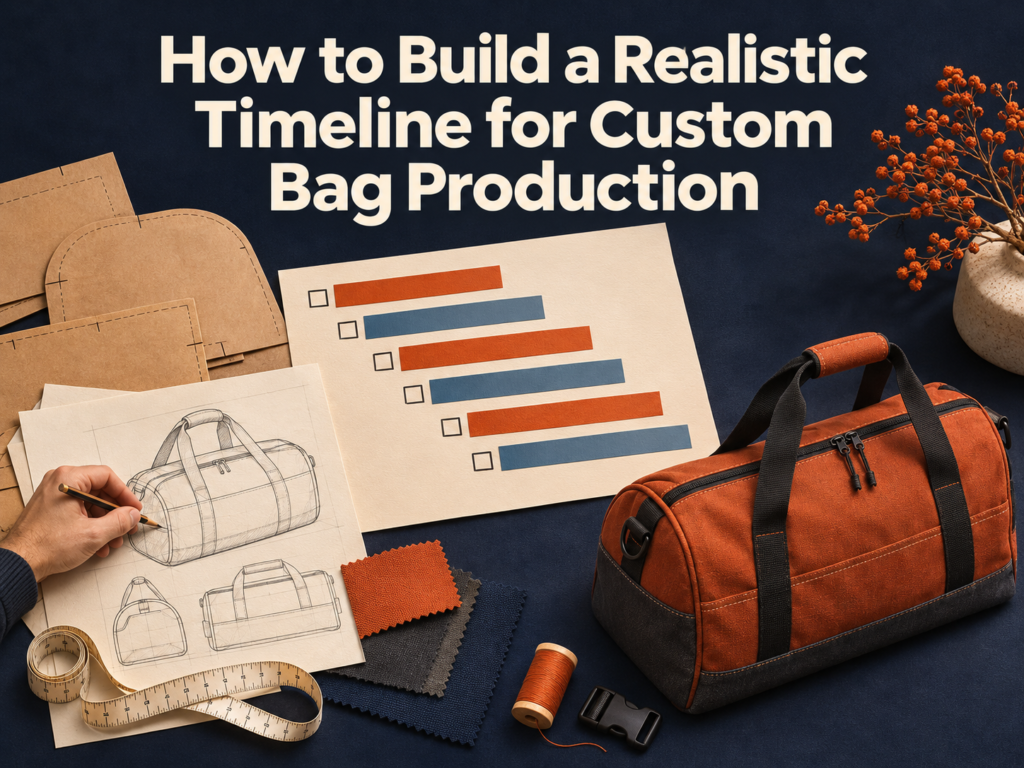
A practical production plan makes those dependencies visible before the order starts. It connects the product specification to material availability, sample decisions, manufacturing capacity and the date the buyer needs usable inventory. Each stage needs an owner, a defined output and a place in the schedule.
For brands developing a new sports bag, the most useful question at the start is what must be ready before the next commitment can be made. That question guides purchasing, sample approval and production release. It also helps the team see when a delay will affect delivery and when another task can continue.
Start with the date inventory must be available
A product launch date can mean several things within the same company. Marketing may mean the day a campaign goes live. Purchasing may mean the day the supplier hands over the cartons. The warehouse may need the goods earlier to count units, check labels and allocate stock. Give the supplier the date by which the inventory must be received at the named destination, then allow for the buyer’s own receiving work.
For an event, define the point at which bags must reach the organiser or fulfilment team. If the bags need to be filled with other merchandise, that work belongs in the schedule. A delivery on the morning of the event leaves no time for preparation. For a retail launch, ask the distribution team when it needs the first saleable units and whether every colour and size must be available together.
Work backward using the logistics arrangement for the actual order. Ask the freight provider for the relevant collection deadlines, planned transit and destination handling assumptions. Record when those estimates were supplied. A production schedule can be developed before the freight booking is final, but the delivery forecast needs updating when the route and booking are confirmed.
| Milestone | What it means for the order | Evidence that closes it |
|---|---|---|
| Production release | The factory can start the agreed bulk operations | Approved specification, material status and release confirmation |
| Manufacturing complete | Assembly has reached the agreed quantity | Completed quantities by SKU and remaining finishing work |
| Cargo ready | The order has met the agreed quality, packing and handover conditions | Release record, packing list, carton measurements and collection arrangement |
| Goods received | The shipment has reached the named receiving site | Delivery and receiving confirmation |
| Inventory available | The buyer can allocate or sell the units | Completed count, label checks and any required preparation |
These dates should appear separately even when they fall close together. A buyer can then ask for an earlier cargo-ready date without assuming that the warehouse will receive the goods on that date. The factory can also show how much time it needs after assembly for the agreed release activities.
Establish the starting conditions before accepting a lead time
A statement such as “production takes 30 days” has limited planning value until the starting conditions are clear. Ask whether the count begins after the order is confirmed, after funds are received, after the final sample is approved or after materials pass incoming inspection. If several conditions apply, list them individually and identify which is still open.
Use a consistent calendar. A material supplier may quote working days while a transport estimate uses calendar days. Factory working weeks, holiday closures and the buyer’s approval calendar can differ. Convert the durations into actual dates with the appropriate calendar for each participant. Include sample courier movements and review appointments where a physical sample is needed to make the decision.
Separate an early forecast from a confirmed commitment. At the concept stage, the manufacturer may be able to estimate a window based on a proposed construction. Once the sample, component orders and production slot are confirmed, that window can become more precise. Keep the assumptions beside the dates so a change in fabric, quantity or construction can be assessed against the right version.
When comparing suppliers, ask them to schedule the same product and assortment. An offer based on stock fabric and an existing pattern will have different starting conditions from one based on a custom colour and new construction. A shorter duration is meaningful only when the buyer can see what is included and what has to happen first.
Get enough of the product brief settled to plan the work
The manufacturer needs a usable brief to estimate development time. Include the bag’s purpose, expected contents, dimensions, carry method, intended load and quantity by variant. Provide artwork and describe the target appearance and feel. If a material or feature is open to suggestions, identify the performance requirement the proposed option must meet.
An unresolved use requirement can create more work than an unresolved trim colour. For a racket bag, the development team needs to know the equipment dimensions and how protection will be provided. For a gym duffel, a separate shoe compartment changes the internal space available for clothing. A backpack with a new shoulder-strap layout may need a loaded wear trial before the pattern can be settled.
Assign the decisions to the people who can make them. The product team may own pocket dimensions and fit, while marketing owns artwork and operations owns packaging labels. Agree who combines their comments and issues the final instruction. Give that person enough time to consult the others before the review deadline.
A brief can evolve during development. Track its revisions so the factory knows which measurements and materials apply to each sample. When a buyer changes the phone pocket after testing a prototype, the new drawing should identify the changed opening and the item it must accept. Clear revisions make the next round easier to estimate because the pattern maker can see the work requested.
Give each sample a decision to resolve
Sampling becomes easier to schedule when each round has a purpose. An early prototype can answer questions about capacity, access and proportion using available materials. A later sample can confirm the actual shell, lining and hardware. The production approval sample should represent the agreed construction closely enough for the buyer and factory to approve what will be made.
Ask which materials in a prototype are temporary. A substitute zipper can be acceptable for checking the shape of an opening, but its behaviour may differ when the final zipper is fitted. A lighter foam can change how a shoulder pad bends. Write down which observations can be approved on the sample in hand and which require confirmation on the next one.
Allow time to receive and use the sample. An internal review may involve packing the bag, carrying it with a representative load, checking the artwork and measuring the folded pack. If those reviews take place in different locations, plan the movement between them or request an additional sample where practical. Agree who needs to see the physical article and which details can be reviewed from drawings or images.
Send consolidated comments with photographs and measurements. Tie each request to a location on the bag and state the expected result. “Increase the usable pocket opening to accept the cased device in the brief” gives the factory a clear task. If the required dimension is known, include it. Ask the supplier to confirm which revisions affect patterns, materials or testing and when the revised sample can be ready.
Track material readiness at component level
A bag can contain dozens of purchased items. Some may be available immediately, while a custom lining, woven label or molded part needs separate production. Build the material schedule from the bill of materials and identify the items that govern the next manufacturing operation.
“Available” needs a quantity and a location. A supplier may have a swatch or enough material for the sample without having enough for the bulk order. Ask whether stock is reserved, whether it is all from an acceptable lot and when the factory can receive it. Include incoming checks in the ready date. Material delivered to the gate may still need colour review, measurement or a construction trial.
Custom colours require a decision route of their own. Specify the colour reference and how it will be judged. Ask when the buyer will receive the colour submission and what happens if it needs another attempt. Where shell fabric, webbing and zipper tape are intended to match, review the set together. Approving each item in isolation can leave an unacceptable combination at assembly.
| Component | Decision needed before commitment | Readiness point used for scheduling |
|---|---|---|
| Shell and lining | Article, colour, finish and required quantity | Received, checked and released for the intended operation |
| Webbing and hardware | Width, fit, colour and pairing | Approved parts available together in the required quantities |
| Logo applications | Artwork, size, placement and process | Approved decoration reference and production supply ready |
| Reinforcement and padding | Thickness, shape and assembly behaviour | Correct parts available after any required cutting or trial |
| Retail packaging | Artwork, barcode mapping and packed dimensions | Approved printed materials delivered and checked |
Agree how early materials may be purchased. Ordering a fixed shell fabric while a pocket is being refined may be a useful way to overlap work. Buying a custom zipper before the opening length is confirmed can commit the buyer to an unusable component. Record who authorizes the purchase and which specification it uses, especially when the order creates excess material or a cancellation charge.
A material order also needs an expected arrival date and a responsible contact. If the factory receives a revised date from a mill, it should translate that change into the operations affected. The buyer then has a concrete decision to make about a substitute, a revised assortment or the delivery forecast.
Estimate production from the actual construction
Order quantity alone does not define manufacturing time. The same number of tote bags, padded backpacks and multi-compartment duffels can require very different amounts of work. Ask the factory to explain the planned operations, the expected output after setup and any operation with limited capacity.
Consider a hypothetical run of 2,000 duffels. If the planned line produces 160 completed bags per working day after setup, assembly would require 12.5 working days at that output. The schedule would therefore need at least 13 production days for that calculation, plus the actual setup and other work outside the estimate. If a decoration process can prepare only 120 sets per day, it may become the limiting operation unless it starts early enough to build a usable supply.
Use demonstrated or planned output for the proposed construction. Ask whether the estimate already includes operators learning a new sequence, normal interruptions and routine checks. Include a first-unit review before the line repeats a mistake across the lot. A difficult bound corner or a thick seam through several layers can need an adjustment to the process or the pattern.
A reserved production slot also needs conditions. Ask when the factory needs the released materials and approval to hold that slot, and what the next available start would be if those inputs arrive late. A two-day approval delay can have a larger effect if it causes the order to miss the available line window.
A worked timeline for 1,200 custom sports bags
The following example is an illustrative planning exercise for a first order of 1,200 sports bags in two colours. It assumes a new pattern, stock shell and lining, custom labels, standard hardware and one planned revision round. It uses an assumed five-day factory working week with no holiday interruption. The buyer needs the inventory available by the end of Week 18.
The durations are project assumptions for the example. Confirm the actual dates with the manufacturer and logistics provider. In this plan, some purchasing starts once the relevant materials are approved, while development continues on details that do not affect those purchases.
| Workstream | Illustrative window | Required input | Completion used by the next stage |
|---|---|---|---|
| Brief and feasibility review | Week 1 | Dimensions, assortment, artwork direction and target use | Agreed development specification |
| First prototype | Weeks 2–3 | Development specification and sample materials | Sample dispatched for review |
| Sample delivery and buyer review | Week 4 | Prototype and review criteria | One consolidated revision instruction |
| Revised sample and construction review | Weeks 5–6 | Approved revision instruction | Pattern and construction decisions closed |
| Material purchase and incoming checks | Weeks 5–8 | Relevant component approvals and purchase authorization | Bulk components released by the end of Week 8 |
| Production approval sample | Week 9 | Agreed pattern and production materials | Written production release |
| Cutting, decoration and assembly | Weeks 10–12 | Release, components and available capacity | Completed order for finishing and inspection |
| Final checks, correction and packing | Week 13 | Finished units and agreed inspection criteria | Released, packed cargo |
| Collection and transport through warehouse delivery | Weeks 14–17 | Cargo release and confirmed logistics arrangements | Goods received at the warehouse |
| Receiving and inventory preparation | Week 18 | Delivered cartons and product records | Stock available for allocation |
The material window overlaps the revised sample because the assumed revision does not change the approved fabric or hardware. If the buyer changes the shell during Week 6, the material plan must be reviewed. The production approval sample depends on the actual bulk components, so a delay in receiving them can affect Week 9.
The factory has an assumed 15 working days across Weeks 10–12 for cutting, decoration and assembly. Its production plan needs to show that the proposed sequence and available resources can deliver 1,200 units in that window. The order quantity by itself does not verify that assumption. Ask when decoration feeds the sewing line and when the last completed units reach final checks.
This schedule also gives the team a way to evaluate a delay. Suppose material release moves from the end of Week 8 to the end of Week 9. If the production sample, line slot and later activities all shift by one week, the plan would reach inventory preparation in Week 19. To retain Week 18, the team would need a confirmed recovery elsewhere. The forecast should show both the new date and the recovery being evaluated.
Keep the schedule current with quantities and remaining work
A useful progress report identifies what has finished, what is waiting and what controls the next milestone. Ask for quantities by SKU when a colour or size can have a different readiness date. The total number of bags in progress can hide the fact that one colour has complete panels and another is still waiting for printed parts.
For example, a report might show 700 bags assembled, 300 at final sewing and 200 sets waiting for front-panel decoration. The follow-up questions concern the decoration output, the supply reaching the line and the time needed to finish the last 200. A forecast based only on the average progress of the first 1,000 units could overlook that constraint.
Keep the original agreed date, the latest forecast and the actual finish as separate fields. The difference shows where the plan changed and whether a recovery worked. If the forecast moves, update the activities that depend on it. Include an action owner and the next decision date, such as approval of an alternative label or confirmation of a revised collection slot.
Choose a reporting frequency that matches the decisions being made. A short development update may be enough while the pattern is being revised. During a tight production window, more frequent quantities can help the buyer decide whether a split shipment is feasible. Keep updates tied to a decision or measurable milestone so the factory can provide the information without duplicating reports.
Put contingency where the uncertainty can affect delivery
Use a range when the duration of an activity is still uncertain. Ask what must go well for the early date and what could lead to the later one. A new shoulder pad may need a second comfort review. A custom-colour submission may require another attempt. A first production run may need process adjustment before reaching the planned output.
Attach contingency to those uncertainties. In the example, Week 13 includes an allowance for agreed correction and packing work. If the first inspection passes and packing finishes early, some of that allowance may remain available. If repair takes longer than the allowance, the cargo-ready forecast changes. Recording the allowance makes its use visible to both teams.
Check the calendars of the parties involved in the controlling activities. A factory may be open while its material supplier or decoration workshop is closed. A buyer’s approval owner may be away when the revised sample arrives. A warehouse may require an appointment after delivery. Convert known constraints into dates and confirm who covers a decision during an absence.
For a fixed event, define the last date on which each recovery option is useful. An alternative material needs time for approval and purchasing. An expedited shipment needs released units and a realistic transport option. Keeping those decision dates visible prevents the team from waiting until an option can no longer help.
Respond to changes with a revised sequence
A late request should come with enough information for the factory to assess the affected work. Moving an internal pocket may require new cut parts and sewing instructions. Changing the shell after materials are purchased can involve replacement supply and another decoration trial. Ask the supplier which completed work can be used, what must be repeated and how the change affects the next available production slot.
Approve the revised specification and its schedule together. Identify the old and new document versions and the point at which the new instruction takes effect. If some units have already been made, agree how those units will be handled. That decision matters for quantities, inspection references and packing records.
When the launch date is fixed, compare recovery options against the units the buyer actually needs. A supplier may be able to complete one colour earlier because all of its parts are ready. A split delivery can help if that colour has commercial value on its own and can be inspected and packed as a defined lot. Check the extra freight, handling and receiving work before choosing it.
Ask for the remaining work behind a revised promise. If a material is five days late, a proposal to recover five days should identify which activities become shorter or overlap and whether the necessary capacity is available. A revised date becomes credible when the team can follow the changed sequence to cargo release and delivery.
Schedule inspection and receiving as operational work
Agree what must be ready for the inspection appointment. The inspector may need an identified lot, access to cartons, approved references and enough completed units to follow the agreed plan. If part of the order is unfinished, confirm whether the visit can serve its intended purpose or needs to move. Include any required functional testing and the time needed to evaluate its results.
Plan how a correctable issue will be handled. A wrong label may require sorting, replacement supply and repacking. A repeated seam issue may need repair followed by a check of the affected units. Identify who reviews the result and authorizes shipment release. The schedule should reflect that decision, especially if the buyer’s quality team operates in another time zone.
Confirm the final pack-out on the finished article. Padding, handles and rigid inserts can affect how many units fit in a carton. Check the carton dimensions and gross weight, then update the logistics provider. Reconcile quantities by SKU with the packing list and verify that product labels match the buyer’s receiving data.
At destination, allow for counting, damage checks and any preparation needed before allocation. If the bag is part of a kit, include the kitting operation. If the warehouse needs an appointment or product records in advance, send those on the required date. Inventory readiness is easier to forecast when the receiving team has been involved before dispatch.
Use first order records to plan the reorder
A repeat order can remove much of the pattern and sample development work. Start by confirming that the existing specification, approved sample and component references still describe the next run. Ask which materials are available, which need replenishment and whether the previous hardware can be obtained in the required quantity.
Review changes to the assortment. A new colour introduces a material approval even when the pattern is unchanged. A revised retail label adds artwork and print supply. An increased quantity can require a longer production window or a different line allocation. Carry those differences into the reorder plan while retaining the approvals that still apply.
Use the first order’s records to improve the next estimate. Compare the planned and actual durations for sample review, material receipt, line output and release. If label approval took longer than expected, move that decision earlier. If the last colour consistently finished after the others, ask the factory to show how the next run will be sequenced.
For partial approvals, name the exact work that can proceed. A buyer might approve the shell colour and authorize that fabric purchase while holding the logo placement for another review. The factory then has a clear instruction for purchasing, and the sample room knows the decoration decision is still open. List the remaining decision and its due date beside the authorization. When the final approval arrives, close that item against the appropriate revision.
Keep a short decision log alongside the timeline. Record the date, the decision maker, the affected component or operation, and the reference used. This helps when a team member changes or an old comment is raised again during inspection. It also gives the reorder team a reliable account of why the approved construction differs from an early sketch.
What to confirm before issuing the purchase order
Before committing the order, review the timeline with the supplier against the current quotation. Check that the price covers the same materials, decoration, packaging and testing shown in the plan. A schedule that assumes an available standard buckle will need revision if the purchase order requests a custom version. Confirm the final assortment because minimums and component availability can vary by colour or size.
Ask how the quoted sample time is counted. A sample completion date might describe the date it leaves the sample room. The buyer still needs to receive it, review it and communicate a decision. Put those activities into the plan with the person responsible for each one. If a second sample is necessary, establish the next dispatch and review dates once the revisions have been assessed.
Check whether the factory has reserved capacity and what it needs to confirm that reservation. Identify any payment or release condition included in the commercial agreement. Give that condition an owner in the buyer’s team so it can be completed before it blocks an operation. Keep the contact details for purchasing, product approval, quality and logistics available to the project coordinator.
Finally, agree how a change in the forecast will be reported. An update should show the affected milestone, the reason, the remaining work and the revised downstream dates. When a recovery option needs a decision, state the cost and the deadline for accepting it. With those points settled, both teams can use the purchase order and schedule as a consistent reference during production.
Plan your next custom bag order with Raketbag
Raketbag supports OEM and ODM sports bag projects through design development, material selection, sampling, branding, packaging and bulk production. When requesting a timeline, send the product brief, quantity by variant, destination and date the goods need to be available. Include the decisions already approved and the areas where development support is needed.
Ask for a schedule that identifies the sample decisions, component readiness dates, production window and release conditions for your specific order. Use it as the working record from the first prototype through receiving, updating the forecast as approvals and completed quantities become known.